Thermodynamic Bookkeeping: How Refrigerators Obey the Second Law While Appearing to Defy It
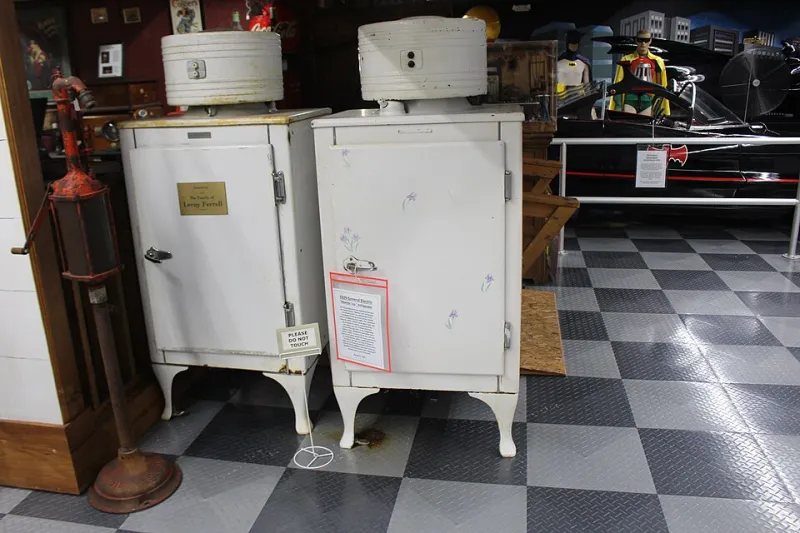
Photo: Michael Rivera, CC BY-SA 4.0, via Wikimedia Commons
The Second Law of Thermodynamics is among the most frequently misunderstood principles in physics—not because it is mathematically complex, but because its implications are so easily overstated. Popular accounts often reduce it to the declaration that heat flows from hot to cold, full stop, as if nature had posted a one-way sign on every thermal gradient. From this reading, a refrigerator looks like a lawbreaker: it demonstrably moves heat from the cold interior of the cabinet to the warm air of your kitchen. If heat flows from hot to cold, how does this device push it the other direction?
The answer lies in a distinction that is easy to state but takes some care to fully appreciate: the Second Law governs entropy in closed systems, not heat flow in isolation. A refrigerator is not a closed system. Once you account for the entire thermodynamic ledger—including the work supplied by the compressor—the entropy of the universe increases during every refrigeration cycle. The law is satisfied, completely and without exception.
Entropy as a Bookkeeping Variable
Entropy is often described informally as a measure of disorder, and while that framing has pedagogical value, it obscures the precise thermodynamic definition. Rigorously, entropy change is defined as the heat transferred reversibly divided by the absolute temperature at which that transfer occurs. The Second Law states that in any real, irreversible process, the total entropy of an isolated system cannot decrease.
This formulation immediately opens space for local entropy reduction. There is nothing in the Second Law that prohibits the entropy of a subsystem from decreasing, provided the entropy of the surroundings increases by at least as much. Living organisms, for instance, maintain extraordinarily ordered internal structures—low local entropy—by consuming energy and expelling heat and waste products that raise the entropy of their environment. The net entropy change is always positive.
A refrigerator operates on exactly the same accounting principle. The refrigerant inside the system absorbs heat from the cold interior, reducing the entropy of the food and air inside the cabinet. But the compressor, driven by electrical work, forces that heat—plus additional heat generated by the compressor's own irreversibilities—into the kitchen air. The entropy gained by the kitchen exceeds the entropy lost by the refrigerator interior. The ledger balances, with a surplus on the entropy side.
The Carnot Cycle and the Limits of Efficiency
To understand how much work a refrigeration cycle must consume, it helps to examine the idealized case first. The Carnot cycle, developed by French engineer Sadi Carnot in 1824, describes a reversible heat engine operating between two thermal reservoirs at temperatures T_hot and T_cold. Run in reverse, this cycle becomes an ideal refrigerator—or, depending on which heat exchange is the useful output, an ideal heat pump.
The coefficient of performance (COP) for an ideal Carnot refrigerator is defined as the heat removed from the cold reservoir divided by the work input required. Mathematically, this is T_cold divided by the difference (T_hot minus T_cold), where temperatures are expressed in Kelvin. Several important conclusions follow immediately.
First, the COP is always finite and always greater than zero—meaning that a refrigerator never violates energy conservation. Work must always be supplied. Second, the COP increases as the temperature difference between the two reservoirs decreases. Cooling a space to just a few degrees below room temperature is thermodynamically inexpensive; cooling it to near absolute zero requires work input that grows without bound as the target temperature approaches zero Kelvin. This is why cryogenic cooling systems for superconducting research applications consume enormous amounts of electrical power relative to the heat they extract.
Third, and most importantly for understanding the Second Law, no real refrigerator can exceed the Carnot COP. Real systems are irreversible—compressors generate friction heat, heat exchangers operate across finite temperature differences rather than infinitesimal ones, and refrigerants undergo real gas behavior that deviates from the ideal. These irreversibilities always reduce efficiency below the Carnot limit, which means they always generate additional entropy. The Second Law is not merely satisfied; it is satisfied with room to spare.
The Vapor-Compression Cycle in Practice
Virtually every household refrigerator in the United States operates on the vapor-compression cycle, a practical implementation of the reversed Carnot concept. The cycle has four stages, each corresponding to a component in the appliance.
In the evaporator, low-pressure liquid refrigerant absorbs heat from the cabinet interior and vaporizes. This phase change occurs at constant pressure and constant temperature, and it is the step that actually cools your food. The refrigerant vapor then enters the compressor, where electrical work raises its pressure and temperature significantly. The high-pressure, high-temperature vapor flows into the condenser—the coils typically located at the back or bottom of the refrigerator—where it releases heat to the kitchen air and condenses back to liquid. Finally, the liquid passes through an expansion valve, dropping in pressure and temperature, and the cycle repeats.
The condenser is where the entropy accounting becomes visible. Touch the back of a running refrigerator and you will feel warmth—that is the heat extracted from the interior plus the heat equivalent of the electrical work consumed by the compressor, all being discharged into the room. A refrigerator does not eliminate heat; it relocates and augments it.
Heat Pumps and the Reversibility of the Framework
The same vapor-compression cycle, operated with a different objective, becomes a heat pump. Where a refrigerator treats the cold-side heat extraction as the useful output, a heat pump treats the warm-side heat rejection as the useful output. In heating mode, a heat pump extracts thermal energy from outdoor air—even at temperatures well below freezing—and delivers it to the interior of a building at higher temperature, with work input from the compressor.
This is why heat pumps can deliver more thermal energy to a building than the electrical energy they consume. A heat pump with a COP of 3.0 delivers three units of heat for every unit of electrical work—the remaining two units come from the outdoor environment. This does not violate energy conservation; it exploits the thermodynamic leverage available when moving heat across a modest temperature gradient rather than generating it directly.
As outdoor temperatures drop, the temperature differential increases, the Carnot limit tightens, and the COP of a real heat pump falls. At extreme cold—the kind experienced during a polar vortex event in the Midwest—heat pump efficiency can drop enough that supplemental electric resistance heating becomes necessary. This is a thermodynamic constraint, not an engineering failure.
The Second Law as a Design Constraint
Engineers designing refrigeration and heat pump systems do not fight the Second Law; they navigate within it. Every design decision—refrigerant selection, heat exchanger surface area, compressor efficiency, expansion valve geometry—represents an attempt to minimize the gap between real-world performance and the Carnot ideal. That gap is the cost of irreversibility, and it is always paid in entropy.
The misconception that refrigerators somehow circumvent thermodynamic law is, in a sense, a compliment to the elegance of the engineering. The physics works so smoothly, and the result—a cold box sitting in a warm room—looks so improbable, that the underlying compliance with natural law is easy to overlook. But every cycle of every refrigerator, from the unit keeping vaccines stable in a rural clinic to the industrial chillers cooling a data center in Virginia, is a precise and unbroken demonstration of the Second Law in action.