Centripetal Force, Clothoid Curves, and Energy Exchange: The Rigorous Physics Engineered Into Every Roller Coaster
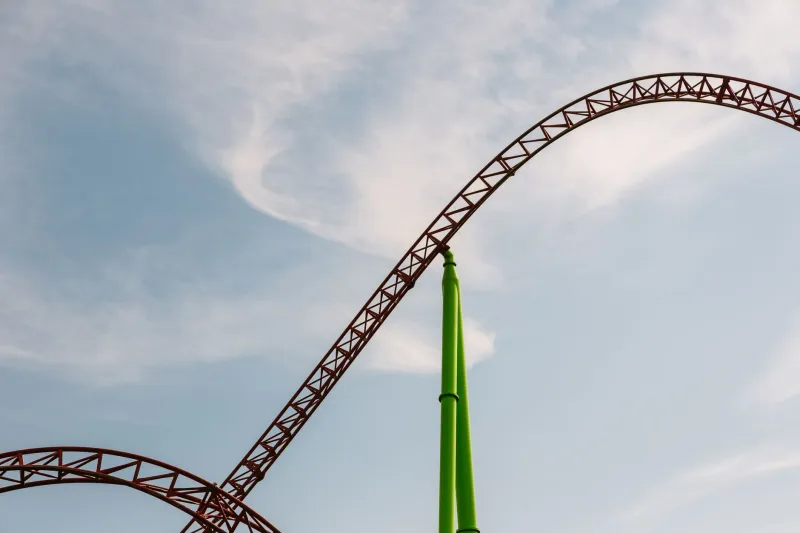
Every summer, tens of millions of Americans queue for a few seconds of controlled terror aboard steel and wood structures that, at their core, are elaborate demonstrations of Newtonian mechanics. A roller coaster does not require a combustion engine once it crests its first hill. From that point forward, the ride is governed almost entirely by the same equations that describe planetary orbits and projectile motion. What separates an exhilarating experience from a dangerous one is the precision with which engineers apply those equations to every curve, drop, and inversion along the track.
The Energy Budget: Potential, Kinetic, and What Gets Lost Along the Way
The foundational principle of coaster physics is the conservation of mechanical energy. At the top of the lift hill, a train possesses gravitational potential energy proportional to its mass and height above the ground, expressed as PE = mgh. As the train descends, that stored energy converts to kinetic energy — KE = ½mv² — and speed increases accordingly. The relationship is direct: a train dropping 200 feet ideally reaches approximately 76 miles per hour at the base of that drop, assuming no energy losses.
In practice, losses are unavoidable. Friction between wheel assemblies and the track, aerodynamic drag acting on the train and its passengers, and the mechanical resistance within the chassis itself all bleed energy from the system continuously. Engineers at facilities like Cedar Point in Sandusky, Ohio — home to some of the most technically demanding steel coasters in the world — must account for these dissipative forces meticulously. The track layout is calibrated so that each successive hill is shorter than the preceding one, ensuring the train retains sufficient kinetic energy to complete the course. A hill taller than the energy budget permits would bring the train to a halt, a condition known in the industry as a rollback.
This is why the lift hill height is not an arbitrary aesthetic choice. It is the initial energy deposit that funds every subsequent maneuver on the circuit.
Why Loops Are Not Circles: The Clothoid Solution
Early roller coaster loops, constructed in the late nineteenth and early twentieth centuries, were geometrically circular. Riders on these attractions suffered significant physiological distress, and several installations were closed after causing injuries. The problem was not the loop itself but the uniformity of its curvature.
In a circular loop, the radius of curvature is constant throughout. At the bottom of the loop, where the train moves fastest, centripetal acceleration — defined as a = v²/r — is at its maximum. The normal force a rider experiences, which is the force the seat exerts upward against the body, equals the sum of gravitational force and the centripetal force required to maintain circular motion. At high entry speeds, this value can reach five or six times the force of gravity, compressing the body with enough intensity to impair blood flow to the brain and cause grayout or blackout.
Modern coasters universally employ the clothoid loop, also called the Euler spiral or Cornu spiral, a geometric form in which the radius of curvature changes continuously along the arc. Specifically, the loop is tightest at the top — where the train is moving slowest — and widest at the bottom — where the train is moving fastest. This inverse relationship between speed and radius moderates the centripetal acceleration throughout the loop, distributing g-forces more evenly across the rider's experience.
The result is a loop that feels intense without becoming physiologically hazardous. Millennium Force at Cedar Point and the Kingda Ka installation at Six Flags Great Adventure in New Jersey both incorporate clothoid geometry in their inversion sequences, as do virtually all contemporary steel coasters designed to meet modern safety standards.
Reading G-Forces as a Physics Instrument
The sensation riders describe as being "pushed into the seat" or "lifted out of the seat" corresponds directly to measurable changes in normal force. Engineers and physicists express this as a multiple of standard gravitational acceleration, denoted g, where 1g represents the ordinary weight a person feels standing still on Earth's surface.
Positive g-forces, experienced at the bottom of drops and through banked turns, compress the rider downward. Sustained exposure above approximately 5g can induce loss of consciousness in an unbraced individual. Negative g-forces — commonly called airtime — occur when the track curves downward faster than gravity alone would accelerate the train, effectively reducing the normal force below zero and lifting riders momentarily out of their restraints. Wooden coasters, and certain steel designs optimized for airtime such as the Intimidator 305 at Kings Dominion in Virginia, are particularly prized by enthusiasts for generating sustained negative-g moments over camelback hills.
The precise measurement and management of these force profiles is not guesswork. Computational fluid dynamics software and rigid-body simulation tools allow designers to model the forces acting on a hypothetical passenger at every point along the track before a single piece of steel is fabricated. Regulatory bodies and park operators then verify these predictions using instrumented test dummies and accelerometer arrays during the commissioning phase.
Friction, Banking, and the Geometry of Lateral Forces
Vertical loops represent only one dimension of the engineering challenge. Horizontal curves introduce lateral acceleration, which riders perceive as a sideways push. Unmanaged lateral g-forces are both uncomfortable and potentially injurious, so track designers bank curves — tilting the track inward — to redirect the net force vector more closely toward the rider's spine rather than their side.
The required bank angle for a given curve depends on the train's velocity and the radius of the turn, derived from the same centripetal acceleration formula. At higher speeds or tighter radii, steeper banking is required. Coasters that traverse significant changes in speed along a curved section — as is common on circuits with elevation changes embedded within turns — must compromise on a single bank angle that is acceptable across the range of velocities the train will encounter at that location.
Friction also plays a structural role in this calculation. Magnetic braking systems, now standard on most contemporary steel coasters, use eddy currents induced in conductive fins by permanent magnets to decelerate the train without physical contact. This eliminates the wear and heat generation associated with traditional skid brakes and allows engineers to modulate deceleration forces smoothly — another application of electromagnetic physics serving the goal of controlled, predictable force delivery.
The Coaster as a Living Curriculum
What makes roller coasters particularly valuable from a physics education standpoint is their immediacy. The equations governing a coaster's behavior are not hypothetical constructs — they are experienced directly, in real time, by anyone willing to take a seat. The drop from the top of Fury 325 at Carowinds in Charlotte, North Carolina, which stands 325 feet tall and reaches 95 miles per hour, is a visceral confirmation of energy conservation. The sustained airtime over the hills of El Toro at Six Flags Great Adventure is a bodily encounter with negative normal force.
For students of physics, these experiences provide an intuitive scaffold on which formal mathematical understanding can be built. For researchers and engineers, the coaster industry represents a domain where classical mechanics is applied with high precision under strict safety constraints — a discipline that demands both theoretical rigor and practical ingenuity. In this sense, the American theme park is not merely a venue for entertainment. It is, as the machinery of its rides makes plain, a laboratory that operates at full scale.