Clocks That Crawl: Gravitational Time Dilation, Black Holes, and the Physics of Deep Space Travel
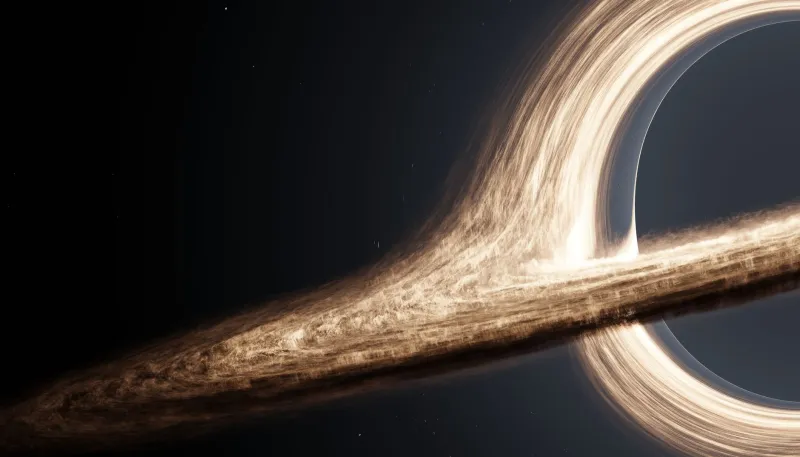
Time, in everyday experience, feels universal — a shared river flowing at the same rate for everyone. General Relativity dismantles that intuition completely. According to Einstein's 1915 field equations, the rate at which time passes is not a constant but a variable, one that depends directly on the curvature of spacetime produced by mass and energy. Near objects of extreme gravitational intensity — black holes, neutron stars — this effect ceases to be a minor correction and becomes the dominant feature of any physical description. For researchers contemplating crewed missions into deep space, gravitational time dilation is not a philosophical curiosity. It is an engineering constraint.
The Theoretical Foundation: What General Relativity Actually Predicts
The core insight of General Relativity is that mass curves spacetime, and that objects — including light, and the ticks of a clock — follow geodesics through that curved geometry. Time dilation near a massive, non-rotating (Schwarzschild) body is described by a precise mathematical relationship. The ratio of proper time elapsed for an observer at radial distance r from a mass M to coordinate time measured by a distant observer is:
dτ/dt = √(1 − 2GM/rc²)
Here, G is the gravitational constant, c is the speed of light, and the quantity 2GM/c² defines the Schwarzschild radius rₛ — the radius at which the denominator under the square root approaches zero, and time dilation becomes theoretically infinite. This is the event horizon of a non-rotating black hole.
The practical consequence is that as r decreases toward rₛ, the factor dτ/dt approaches zero. A clock placed very close to the event horizon ticks extraordinarily slowly relative to a clock held by a distant observer. At r = rₛ itself, the coordinate time required for any physical process becomes infinite — from the outside perspective, time appears to stop entirely.
Experimental Confirmation: From Pound-Rebka to GPS
Gravitational time dilation is not speculative. It has been confirmed experimentally with remarkable precision at scales accessible from Earth's surface. In 1959, Robert Pound and Glen Rebka at Harvard demonstrated that gamma rays traveling upward through a 74-foot tower experienced a measurable frequency shift consistent with General Relativity's predictions — a result that required accounting for the difference in gravitational potential between the emitter and receiver.
 Photo: Robert Pound, via www.scottishfield.co.uk
More practically, the Global Positioning System provides an ongoing, operationally critical demonstration of the effect. GPS satellites orbit at approximately 20,200 kilometers altitude, where Earth's gravitational field is weaker than at the surface. Clocks aboard those satellites run faster than ground-based clocks by approximately 45 microseconds per day due to gravitational time dilation (partially offset by a velocity-based special relativistic effect of about 7 microseconds per day). Without continuous relativistic corrections, GPS positioning errors would accumulate at roughly 6.9 miles per day — rendering the system useless within hours. The fact that GPS works is, in a very direct sense, daily empirical confirmation of Einstein's predictions.
Scaling Up: The Environment Near a Black Hole
Near a stellar-mass black hole — say, one with a mass ten times that of the Sun — the Schwarzschild radius is approximately 30 kilometers. An observer hovering at a distance of just 1.5 times the Schwarzschild radius (roughly 45 kilometers from the singularity) would experience time dilation by a factor of approximately √(1 − 2/3) ≈ 0.577. For every hour that passes for this observer, nearly 1.73 hours would elapse for a distant observer. Move closer still, to 1.1 times the Schwarzschild radius, and the factor drops to approximately 0.30 — one hour near the horizon corresponds to more than three hours at a safe distance.
Supermassive black holes, such as M87*, which carries a mass of approximately 6.5 billion solar masses and was famously imaged by the Event Horizon Telescope collaboration in 2019, produce proportionally larger Schwarzschild radii. However, the tidal forces near the event horizon of a supermassive black hole are actually weaker than those near a stellar-mass black hole, because the tidal force scales inversely with the square of the Schwarzschild radius. This means that, at least in principle, a spacecraft could approach the event horizon of a sufficiently massive black hole without being immediately destroyed by tidal disruption — though the time dilation effects would be equally extreme.
The scenario depicted in the film Interstellar — in which one hour on a planet near a massive black hole corresponds to seven years for an observer in orbit farther away — is, while dramatically compressed for narrative purposes, physically coherent in its underlying premise. The specific numbers require a near-extremal Kerr (rotating) black hole, but the qualitative phenomenon is exactly what General Relativity predicts.
Implications for Crewed Deep Space Missions
NASA's current deep space research programs, including the Artemis architecture and the ongoing study of potential crewed missions to Mars, do not yet grapple seriously with gravitational time dilation because the gravitational environments involved are relatively gentle. The time dilation experienced during a Mars transit is dominated by velocity effects (special relativistic) and is measured in milliseconds over the course of a mission — operationally trivial.
However, hypothetical missions to regions of extreme gravity would introduce complications that have no precedent in mission planning. Consider a scenario in which a crewed spacecraft were to enter a stable orbit at 1.1 Schwarzschild radii around a stellar-mass black hole and remain there for what the crew experiences as one week. The time dilation factor of approximately 0.30 means that roughly 3.3 weeks would have passed for mission controllers on Earth — or, more precisely, for any observer far from the gravitational source. Communication delays aside, the mission would return to a world that had aged more than three times as fast as the crew.
For longer excursions, the asymmetry becomes profound. A crew experiencing one year near such an object would return to find that more than three years had passed back home. Family members would have aged; institutional knowledge would have shifted; the political and scientific landscape would have changed. These are not merely philosophical concerns — they represent genuine human factors that mission planners would be required to address, from crew psychological preparation to legal frameworks governing property and employment.
Furthermore, sustaining a spacecraft at 1.1 Schwarzschild radii would require an extraordinary propulsive force to counteract the gravitational pull — a force that, using any propulsion technology currently under development or seriously proposed, is physically unachievable. The practical ceiling for crewed missions in the foreseeable future remains well outside any regime where time dilation constitutes a mission-critical variable.
What the Mathematics Teaches Us
For students of General Relativity, the Schwarzschild metric and its time dilation formula represent one of the most pedagogically powerful results in all of theoretical physics. The equation is compact, its derivation is accessible to anyone with a foundation in differential calculus and special relativity, and its consequences are both verifiable and deeply counterintuitive.
The broader lesson that gravitational time dilation imparts — that the geometry of spacetime is a dynamic, physical entity rather than a fixed background — is the conceptual cornerstone upon which modern astrophysics, cosmology, and gravitational wave astronomy are all built. The detections made by LIGO and Virgo since 2015, the imaging of black hole shadows, and NASA's ongoing research into the gravitational environments of compact objects all rest on the same theoretical framework that predicts clocks run slower in stronger fields.
Time, it turns out, is not the impartial referee of physical events that Newton imagined. It is a participant — curved, stretched, and slowed by the very matter it helps to locate. Near a black hole, that participant nearly stops speaking altogether.