Tuck, Pike, Extend: How Conservation of Angular Momentum Decides Every Olympic Dive
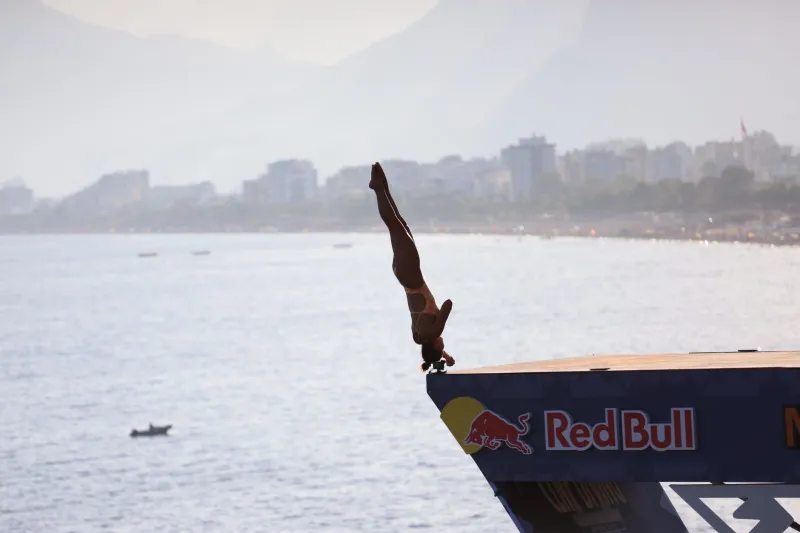
At the 2020 Tokyo Olympics, Chinese diver Quan Hongchan completed a back two-and-a-half somersault with two-and-a-half twists from the ten-meter platform and entered the water so cleanly that the splash barely cleared her ankles. She was fourteen years old, and she scored a perfect 10 from every judge. What the scoreboard did not display — but what the physics encoded in every frame of that dive — was a precise, real-time manipulation of rotational inertia that no motor, spring, or mechanical device assisted. The only machinery involved was the conservation of angular momentum.
For students of physics, competitive diving is among the most instructive spectacles in sport. It isolates a single conserved quantity — angular momentum — and makes its consequences visible, dramatic, and measurable. For researchers in biomechanics, it represents a living laboratory where the gap between theory and elite human performance is narrower than almost anywhere else.
The Foundational Principle: Angular Momentum Is Not Negotiable
Angular momentum, denoted L, is defined as the product of an object's moment of inertia I and its angular velocity ω: L = Iω. In the absence of external torques — which is precisely the condition a diver achieves once airborne — this quantity is conserved. The atmosphere exerts negligible torque. Gravity acts through the diver's center of mass and therefore produces no net rotational effect. From the instant of takeoff to the moment of water entry, L is fixed.
What the diver can change, however, is how that fixed angular momentum is distributed between I and ω. Moment of inertia measures how mass is arranged relative to the axis of rotation. Pull mass closer to the axis — by drawing the knees to the chest, for instance — and I decreases. Because L cannot change, ω must increase proportionally. The spin accelerates. Extend the body into a straight layout, and I increases dramatically, slowing rotation to a near halt.
This is not a metaphor or an approximation. It is the same principle that causes a figure skater to accelerate when pulling in their arms, and the same principle that governs the collapse of rotating neutron stars. The diver's body is simply a more accessible demonstration.
Three Positions, Three Inertial Regimes
World Aquatics (formerly FINA) officially recognizes three body positions in competitive diving: tuck, pike, and free (which typically defaults to layout for platform events).
The tuck is the most compact configuration available to a human body. With knees drawn to the chest and heels pulled toward the seat, the diver's mass is concentrated tightly around the rotational axis. Biomechanics researchers at institutions including the United States Olympic and Paralympic Committee's training centers have measured the moment of inertia in a full tuck at roughly 3 to 4 kg·m² for an adult male diver — a dramatic reduction from the layout value. The result is rapid, almost mechanical-looking rotation that allows divers to complete multiple somersaults in a compressed time window. The tradeoff is reduced visual elegance, which FINA scoring panels penalize under execution criteria.
The pike positions the body at the hips with legs straight and arms reaching toward the feet. It is geometrically intermediate: more compact than a layout but less so than a full tuck. Moment of inertia values in a deep pike are typically 20 to 40 percent higher than in a tuck, producing proportionally slower rotation. The pike is widely regarded as the most technically demanding position because it requires both hamstring flexibility and precise hip angle control to maintain form under rotational load. Judges award higher base difficulty scores to dives performed in pike precisely because the margin for error is smaller.
The layout — sometimes called the straight position — extends the body fully, maximizing the distribution of mass from the rotational axis. Moment of inertia in a layout can reach 12 to 15 kg·m² or higher depending on body proportions. Rotation slows substantially, which is why layout positions are used not for generating spin but for controlling the final entry angle. A diver completing a forward three-and-a-half somersault in tuck must open to a near-layout in the last fraction of a second to arrest rotation and achieve the vertical entry that judges reward.
The Entry Problem: Timing Angular Deceleration
Perhaps the most physically demanding moment in any dive is not the rotation itself but the transition out of it. A diver who has generated angular velocity in a tuck or pike must shed that velocity before contacting the water — but they cannot shed angular momentum. They can only redistribute it by extending their body and, critically, by timing that extension to coincide with vertical alignment.
High-speed video analysis, now standard at elite training facilities across the United States, allows coaches to measure the angular velocity at every phase of a dive with frame-by-frame precision. Force plates embedded in springboard and platform surfaces capture the impulse generated at takeoff, providing initial angular momentum values that biomechanics staff use to back-calculate the optimal tuck or pike duration for each dive in a competitor's repertoire. The data reveal that the transition from tuck to layout in a platform dive typically occurs within a 50- to 80-millisecond window — a time interval far below the threshold of conscious control. Elite divers rehearse this transition until it is encoded as motor memory rather than deliberate decision.
Researchers at university sports science programs, including groups affiliated with NCAA diving programs at Stanford and Indiana University, have used inertial measurement units — small sensor arrays attached to the limbs — to map three-dimensional angular velocity throughout dive sequences. These studies have confirmed that even minor asymmetries in arm position during a tuck, on the order of a few centimeters, introduce lateral torques that manifest as visible wobble at entry. What appears to a casual viewer as a small splash is the product of eliminating those asymmetries through years of precisely quantified practice.
Scoring Physics: How FINA Criteria Map to Mechanical Variables
World Aquatics scores competitive dives on a scale from 0 to 10, with judges assessing starting position, takeoff, flight, and entry. Each criterion corresponds, sometimes directly, to a physical variable. Entry score reflects how closely the diver's body approximates a vertical line at water contact — which is a measure of how precisely angular velocity was zeroed out at the correct moment. Flight score captures the cleanliness of the chosen body position, penalizing the bent knees or splayed arms that represent deviations from the intended inertial configuration. Takeoff score rewards the generation of sufficient angular momentum without visible effort, since judges penalize the appearance of muscular strain at departure.
The degree of difficulty (DD) multiplier assigned to each dive encodes the physics implicitly. Dives requiring more rotations in a pike or layout — configurations with higher moment of inertia — carry higher DD values because generating equivalent angular velocity from a higher-inertia position demands greater takeoff impulse and more precise execution throughout.
A System Governed by One Number
What makes competitive diving compelling as a physics demonstration is its parsimony. A single conserved scalar quantity — angular momentum established at the moment of takeoff — determines everything that follows. The diver cannot add to it, cannot subtract from it, and cannot appeal to any external mechanism to correct a mistake. They can only redistribute it within their own body, using geometry and timing as their only tools.
For researchers in biomechanics, sports science, and classical mechanics, the diving platform is a remarkably clean experimental environment. For the athletes performing on it, the conservation of angular momentum is not an abstract principle from a textbook — it is the physical law that, on a good day, produces a perfect entry and a score of ten.