Exposed on All Sides: The Thermodynamic Reason Bridges Ice Over Long Before the Road Beneath Them
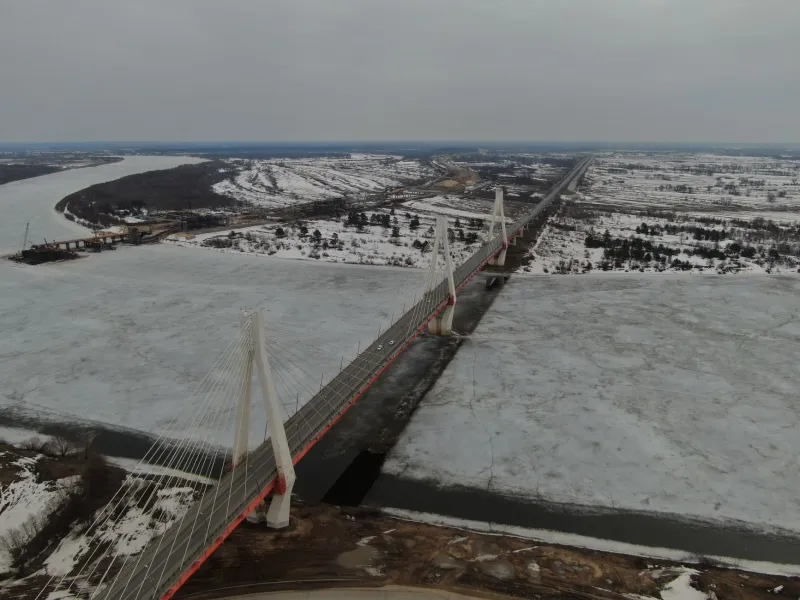
Drive almost any American interstate in December or January and you will encounter a familiar yellow warning sign: Bridge Freezes Before Road Surface. Most drivers treat it as a routine caution, something to acknowledge and move past. Yet embedded within that simple phrase is a precise thermodynamic argument — one that draws on radiation physics, conductive heat transfer, and the thermal properties of construction materials. Understanding why bridges behave so differently from ground-level pavement requires examining how heat moves through and away from solid structures, and why geometry alone can determine whether ice forms or does not.
Heat Transfer: Three Pathways, One Outcome
Physicists recognize three fundamental mechanisms by which thermal energy is transported: conduction, convection, and radiation. In most real-world scenarios, all three operate simultaneously, and the relative dominance of each depends on the geometry, material properties, and environmental conditions of the system in question. Bridges and roads share the same ambient air temperature and precipitation, yet they shed heat through these three pathways in profoundly different proportions — and that asymmetry is the crux of the problem.
A ground-level road is thermally coupled to the earth beneath it. Soil, particularly at depths below the frost line, maintains a relatively stable temperature year-round — in much of the continental United States, this hovers between 50°F and 60°F even in midwinter. That geothermal reservoir acts as a continuous heat source, conducting thermal energy upward through the road substrate and into the asphalt or concrete surface layer. The pavement is never truly isolated; it is perpetually receiving a slow but meaningful flux of warmth from below.
A bridge deck enjoys no such luxury. Elevated above the ground by its supporting structure, the deck is surrounded by air on its underside, its sides, and its top surface. This geometric reality transforms a single-surface heat exchange problem into a multi-surface one, with consequences that are both intuitive and quantitatively significant.
The Stefan-Boltzmann Law and Radiative Cooling
Every object with a temperature above absolute zero emits thermal radiation, and the rate at which it does so is governed by the Stefan-Boltzmann law: the power radiated per unit area is proportional to the fourth power of the object's absolute temperature. For a bridge deck at, say, 35°F (approximately 275 K), this radiative emission is continuous and occurs from every exposed surface simultaneously.
On a clear winter night — precisely the conditions most dangerous for black ice — the sky acts as an effective radiative sink. With little cloud cover to reflect infrared radiation back toward the ground, the bridge deck radiates energy upward into an atmosphere that returns comparatively little. The net radiative heat loss can be substantial. Ground-level roads experience this same upward radiation from their top surface, but their thermal connection to the earth compensates for a portion of those losses. The bridge deck, radiating from both its top and its underside while receiving no geothermal input, loses energy at a rate the road simply cannot match.
This is not a marginal difference. Studies examining bridge deck temperatures versus adjacent pavement temperatures under identical meteorological conditions routinely document surface temperature differentials of 5°F to 10°F or more. At temperatures near the freezing point of water, a gap of that magnitude is the difference between wet pavement and a sheet of ice.
Convective Exposure and the Role of Wind
Convection — the transfer of heat through the bulk movement of a fluid, in this case air — compounds the radiative disadvantage. Ground-level roads are partially sheltered from wind by surrounding terrain, vegetation, guardrails, and the simple fact that air flowing over flat ground experiences surface friction that slows it near the pavement. A bridge deck, elevated and often spanning an open gap such as a river valley or highway interchange, is exposed to unimpeded airflow across its entire surface, including its underside.
Wind dramatically increases the convective heat transfer coefficient of a surface, accelerating the rate at which thermal energy is stripped away. Engineers express this through Newton's Law of Cooling, which states that the rate of heat loss is proportional to the product of the convective coefficient and the temperature difference between the surface and the surrounding air. Higher wind speeds raise the convective coefficient, and a bridge's exposure to wind on multiple faces means that convective losses are amplified relative to a ground-level road under identical wind conditions.
Specific Heat Capacity and Thermal Mass
Material properties further distinguish the thermal behavior of bridges from that of conventional roads. The concept of specific heat capacity — the amount of energy required to raise one kilogram of a substance by one degree Celsius — determines how quickly a material's temperature responds to heat gain or loss. Concrete, the dominant material in American bridge construction, has a specific heat capacity of approximately 0.88 kJ/(kg·°C). Steel, widely used in bridge girders and reinforcement, sits near 0.49 kJ/(kg·°C).
These values are not dramatically different from those of asphalt (roughly 0.92 kJ/(kg·°C)), but the critical factor is thermal mass — the total heat stored per unit area of surface, which depends on both specific heat and the effective depth of material participating in heat exchange. A road's thermal mass is augmented by its connection to the deep soil layer beneath it, effectively giving it access to a vast thermal reservoir. A bridge deck's thermal mass is limited to its own structural depth, typically a concrete slab ranging from seven to twelve inches, with no supplemental reservoir below. When ambient temperatures drop rapidly after sunset, the bridge deck's limited thermal mass is exhausted quickly, and surface temperatures fall to freezing well ahead of the road.
Engineering Responses to a Thermodynamic Reality
The physics described here are not merely academic — they have driven concrete engineering solutions in highway design and bridge construction. Many modern bridges in cold-climate states incorporate embedded hydronic heating systems, in which warm fluid circulates through pipes cast directly into the deck concrete, counteracting radiative and convective losses from within the structure. Electrically resistive heating mats serve a similar function in some installations.
Beyond active systems, passive design choices reflect thermal physics as well. Bridge deck drainage is engineered more aggressively than road drainage to prevent water accumulation that would freeze rapidly. Deicing chemical application rates on bridges are calculated separately from road application rates, accounting for the accelerated cooling that elevated structures experience. Traffic management systems in states such as Minnesota, Michigan, and Colorado use real-time bridge deck temperature sensors to trigger variable message signs and pre-treatment protocols before ice has had time to form.
A Warning Sign as a Physics Lesson
The yellow diamond warning sign that alerts drivers to freezing bridges is, in essence, a compressed thermodynamics lecture. It encodes, in six words, the consequences of radiative coupling to a cold sky, convective stripping by unobstructed wind, the absence of geothermal heat input, and the finite thermal mass of an isolated concrete and steel structure. Each of those mechanisms is described by well-established physical laws — the Stefan-Boltzmann relation, Newton's Law of Cooling, Fourier's Law of conductive heat flux — and each contributes measurably to the temperature differential that makes elevated roadways categorically more dangerous than ground-level ones in near-freezing conditions.
For students of physics, the freezing bridge offers a rare opportunity: a phenomenon encountered in daily American life that is entirely and precisely explicable through undergraduate-level thermodynamics. The universe, as it turns out, posts its own warning signs — and they are worth understanding.