Spin, Geometry, and Reaction Time: The Unforgiving Physics Behind Soccer's Penalty Kick
Spin, Geometry, and Reaction Time: The Unforgiving Physics Behind Soccer's Penalty Kick
Few moments in sport carry the compressed tension of a penalty kick. The ball rests twelve yards from goal. A single player faces a goalkeeper who must cover a frame roughly 24 feet wide and 8 feet tall. The crowd falls silent. What follows is not merely a test of nerve—it is a precise, measurable interaction between biomechanics, fluid dynamics, and the hard constraints of human reaction time. When the physics align correctly, the result is mathematically unstoppable.
The Biomechanics of the Approach and Contact Phase
Before aerodynamics enters the picture, the kicker's own body must function as a calibrated mechanical system. The approach angle—typically between 30 and 45 degrees relative to the ball—determines the orientation of the hips at contact and, consequently, the direction of the resultant force vector transmitted to the ball. Research in sports biomechanics consistently identifies this approach angle as one of the primary predictors of both shot velocity and spin axis.
During the swing phase, the kicking leg behaves analogously to a compound pendulum. The hip acts as the proximal pivot, generating angular momentum that propagates distally through the knee and ankle joints in a sequenced kinetic chain. Elite kickers achieve peak foot velocities in the range of 20 to 25 meters per second at the moment of contact. The contact duration itself is remarkably brief—on the order of 8 to 10 milliseconds—meaning the entire mechanical transfer of energy occurs in less time than it takes a single frame of broadcast video to elapse.
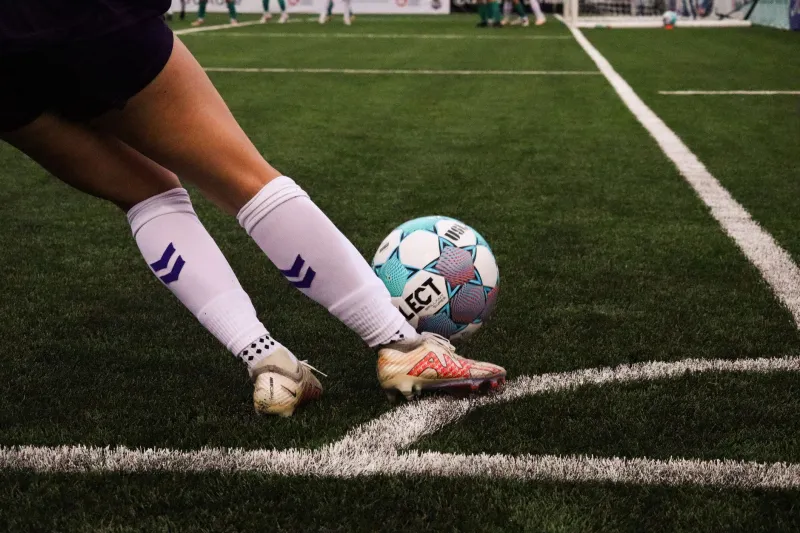
The precise location of foot-to-ball contact governs both the launch angle and the spin imparted. Striking the ball below its horizontal centerline with the instep generates topspin and a lower, faster trajectory. Contact offset to one side of the vertical centerline, achieved by angling the ankle and rotating the hip through the strike, introduces the lateral spin that produces the ball's characteristic curve.
The Magnus Effect: Curvature as a Weapon
Once the ball is airborne, the spin introduced at contact interacts with the surrounding air to produce the Magnus effect—the same aerodynamic phenomenon that governs curveballs in baseball and topspin in tennis. A spinning sphere drags a thin layer of air, the boundary layer, around its surface. On the side where the ball's surface moves in the same direction as the oncoming airflow, the boundary layer accelerates; on the opposite side, it decelerates. This asymmetry in flow velocity produces a corresponding asymmetry in pressure, described quantitatively by Bernoulli's principle, and the resulting net pressure differential deflects the ball's trajectory toward the low-pressure side.
For a penalty kick struck with sidespin, the Magnus force acts laterally, curving the ball away from the goalkeeper's initial dive commitment. The magnitude of this deflection depends on the ball's angular velocity, its translational speed, and the density of the surrounding air. At a rotational rate of approximately 8 to 10 revolutions per second—achievable by professional players—and a translational velocity near 25 meters per second, the ball can deviate laterally by more than a meter over the twelve-yard distance. That deviation can be the difference between a save and a goal.
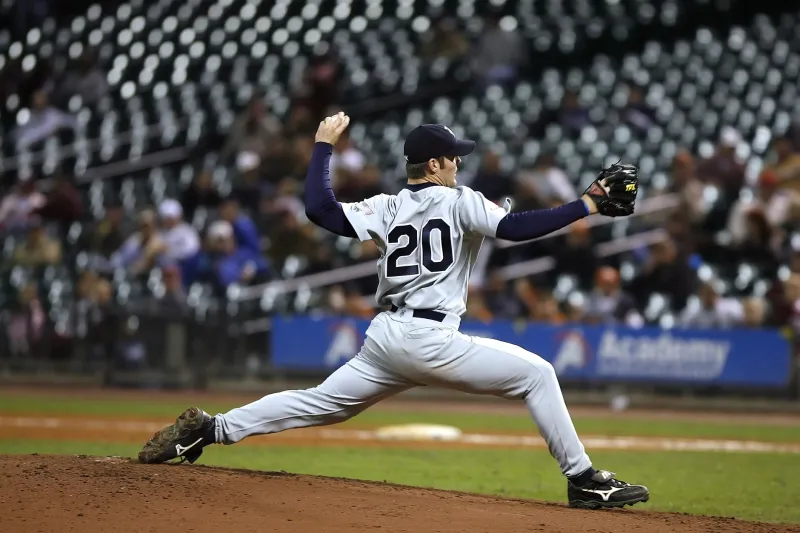
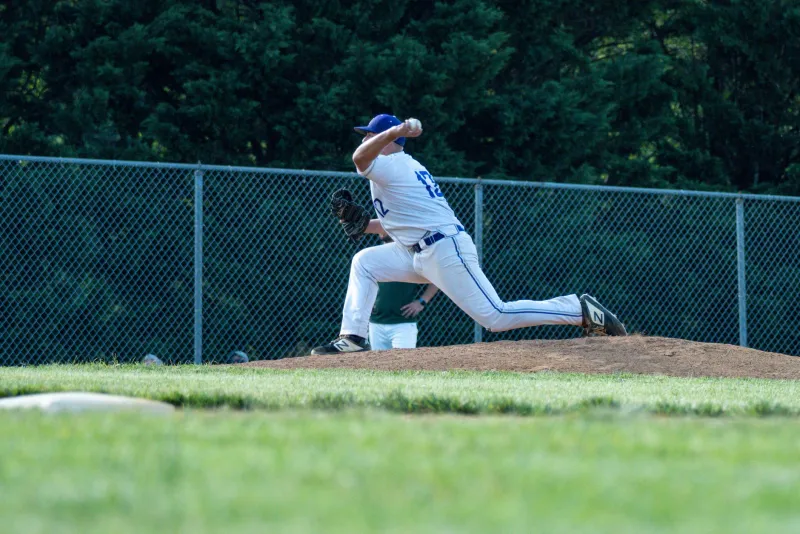
The trajectory is further complicated by boundary layer separation. At intermediate Reynolds numbers—the dimensionless ratio of inertial to viscous forces that characterizes the flow regime—the boundary layer transitions from laminar to turbulent flow partway around the ball's surface. This transition point shifts depending on spin rate, surface texture, and velocity, producing the knuckling instability familiar to goalkeepers facing low-spin shots. Elite kickers can deliberately exploit this instability, striking the ball with minimal spin to induce unpredictable lateral oscillations that no goalkeeper can anticipate.
Optimal Launch Angle and the Geometry of the Goal
The standard penalty spot is placed 11 meters from the goal line. The goal dimensions—7.32 meters wide, 2.44 meters tall—define a finite target that must be reconciled with the ball's parabolic flight path. Classical projectile motion analysis, modified for aerodynamic drag, establishes that the optimal launch angle for maximizing range in a vacuum is 45 degrees, but drag forces substantially reduce that figure for a soccer ball. Accounting for aerodynamic drag coefficients typical of a modern match ball, optimal launch angles for penalty kicks fall closer to 16 to 20 degrees above horizontal for shots directed at the upper corners of the goal.
The upper corners represent the highest-probability scoring zones for a compelling reason rooted in goalkeeper biomechanics rather than pure geometry. A goalkeeper initiating a dive from a standing position requires approximately 0.5 to 0.6 seconds to reach the far post along the ground. Reaching the upper corner of the same post demands both lateral displacement and vertical elevation—a compound movement that extends the required time to roughly 0.7 to 0.8 seconds. A ball struck at 25 meters per second covers the eleven-meter distance in approximately 0.44 seconds. The arithmetic is unambiguous: a well-placed shot to the upper corner arrives before a goalkeeper who commits after the ball is struck can physically intercept it.
The Reaction Time Window: Where Physics Becomes Decision Science
The goalkeeper's dilemma is fundamentally a decision problem constrained by physics. Given that a struck ball reaches the goal in under half a second, and that the human visual system requires roughly 200 milliseconds to process a moving stimulus and initiate a motor response, a goalkeeper who waits for definitive visual information about the ball's destination will invariably be too late. This is why penalty-stopping strategy relies heavily on anticipatory cues—reading the kicker's body posture, plant foot position, and hip orientation in the preparatory phase before contact.
Studies in sports science have demonstrated that experienced goalkeepers extract predictive information from the kicker's non-kicking foot placement and trunk rotation up to 200 milliseconds before ball contact. This anticipatory strategy narrows the goalkeeper's effective reaction window but introduces the risk of committing to the wrong side. Elite kickers, aware of this dynamic, deliberately mask postural cues during the approach—maintaining ambiguous hip and shoulder alignment until the last possible moment—effectively turning the penalty kick into an applied exercise in information theory.
The mathematical window for a truly unstoppable penalty is therefore defined by the intersection of three constraints: a ball velocity high enough to arrive before the goalkeeper can respond to post-contact cues, a placement sufficiently close to the post or crossbar to prevent a pre-committed goalkeeper from reaching it, and a trajectory curved or erratic enough to defeat anticipatory reading. Satisfying all three simultaneously is the physical and cognitive challenge that separates routine penalties from those that leave goalkeepers motionless.
Conclusion
The penalty kick, stripped of its theatrical context, is a remarkably well-defined physics problem. The biomechanical chain that generates ball velocity and spin, the aerodynamic forces that sculpt the trajectory, and the neurological constraints that limit a goalkeeper's response time all interact within a narrow envelope of measurable parameters. When a striker understands and exploits that envelope—consciously or through years of practiced intuition—the result is not luck. It is applied physics, executed under pressure.