Spiral Mechanics: How Angular Momentum, Torque, and Aerodynamic Drag Converge on Every NFL Pass
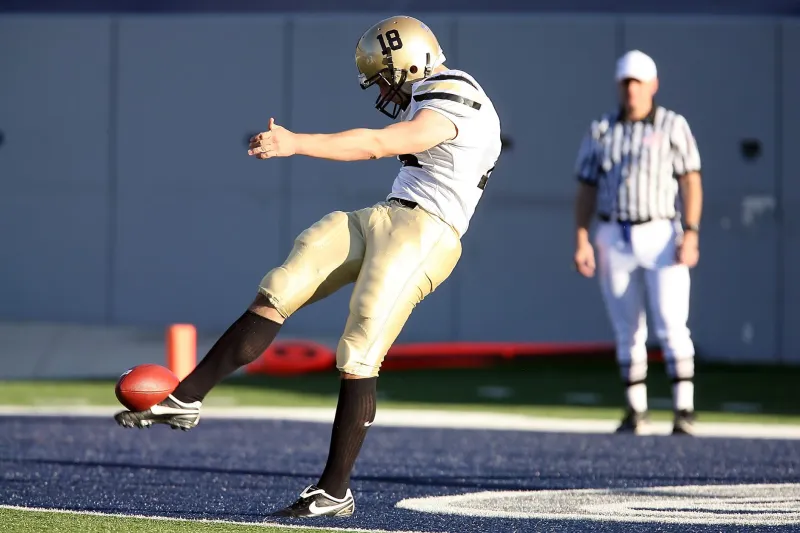
When Patrick Mahomes releases a deep post route throw, the football leaves his hand rotating at roughly 600 revolutions per minute, its long axis tilted slightly upward, its nose cutting through the air with remarkable precision. To the casual observer, this is athleticism. To a physicist, it is a finely tuned interplay of angular momentum, gyroscopic stabilization, aerodynamic drag, and torque — a system whose governing equations have more in common with spacecraft attitude control than with traditional ball-sport mechanics. Understanding why a tight spiral travels farther and more accurately than a wobbling pass requires a careful examination of each physical principle at work.
The Geometry of a Football and Its Aerodynamic Consequences
Unlike a sphere, an NFL football is a prolate spheroid — elongated along its symmetry axis, with pointed ends and a maximum diameter near its center. This geometry has profound aerodynamic implications. When the ball's long axis aligns with its velocity vector, the cross-sectional area presented to oncoming air is minimized, dramatically reducing pressure drag. Conversely, when the ball tumbles or wobbles, the effective frontal area increases substantially, and drag forces scale accordingly. Wind tunnel studies conducted at institutions including the University of Massachusetts Lowell have quantified this effect: a football oriented nose-first at zero degrees of attack experiences roughly 40 percent less drag than one tumbling at 30 degrees of yaw. Over a 50-yard pass, that difference translates into measurable reductions in range and terminal velocity.
The coefficient of drag (C_d) for a football is not constant; it varies with both the Reynolds number — a dimensionless ratio comparing inertial to viscous forces in the surrounding airflow — and the angle of attack. At typical throwing speeds of 50 to 60 miles per hour, the flow around the ball is turbulent, and small deviations in orientation produce disproportionately large changes in drag force. Maintaining near-zero angle of attack throughout the trajectory is therefore not merely aesthetically desirable; it is aerodynamically essential.
Gyroscopic Stability and the Role of Spin
The mechanism that keeps a well-thrown spiral aligned with its trajectory is gyroscopic stabilization, a direct consequence of angular momentum conservation. When a quarterback imparts spin to the ball about its symmetry axis, the resulting angular momentum vector L points along that axis. By Newton's second law for rotation, a net torque is required to change the direction of L. In the absence of destabilizing torques, the ball's symmetry axis remains fixed in space — a phenomenon identical in principle to the behavior of a gyroscope or a rifled bullet.
The magnitude of angular momentum is given by L = Iω, where I is the moment of inertia about the spin axis and ω is the angular velocity. For a regulation NFL football, I is approximately 3.3 × 10⁻³ kg·m², and at 600 rpm (ω ≈ 62.8 rad/s), the angular momentum magnitude is roughly 0.21 kg·m²/s. This is sufficient to resist the destabilizing aerodynamic torques that arise from asymmetric pressure distributions around the ball during flight. Slow-motion analysis studies, including work published in sports engineering journals, confirm that balls thrown with higher spin rates exhibit less precession and maintain tighter nose alignment over longer distances.
It is worth noting that gyroscopic stabilization does not eliminate precession entirely. Any torque applied perpendicular to L — such as that produced by aerodynamic lift acting on a slightly tilted ball — causes the symmetry axis to precess around the angular momentum vector. Elite quarterbacks intuitively compensate for this by adjusting release angle so that the precession cone remains small, keeping the ball's nose tracking closely along the velocity vector throughout the parabolic arc.
Release Angle, Wrist Snap, and the Transfer of Torque
The spin imparted to a football originates almost entirely from the quarterback's wrist snap at the moment of release. Biomechanical analyses using high-speed cameras and inertial measurement units — tools now routinely employed by NFL teams — reveal that peak wrist angular velocity during a throw can exceed 1,500 degrees per second. The torque transmitted to the ball depends on both the force applied by the fingertips and the moment arm over which that force acts, which is why grip technique and finger placement are subjects of intense coaching attention at every level of the sport.
Release angle interacts with spin in a subtle but important way. Ideally, the ball's symmetry axis at release should be tilted slightly above the velocity vector — a configuration called a positive angle of attack — so that as the trajectory curves downward under gravity, the gyroscopic axis naturally follows, maintaining alignment. If the release angle is too steep or the spin axis is misaligned, the ball will develop a persistent angle of attack, generating both increased drag and an aerodynamic lift force that deflects the trajectory unpredictably. NFL Next Gen Stats data, which tracks ball position at high temporal resolution using on-field sensors, has allowed researchers to infer these release parameters indirectly and correlate them with completion probability on deep routes.
Lift, Magnus Effect, and Trajectory Shaping
A spinning prolate spheroid moving through air also experiences a Magnus-like force arising from the asymmetric boundary layer separation on opposite sides of the ball. For a football with right-handed spiral spin (as thrown by most right-handed quarterbacks), this force has a lateral component that can subtly curve the flight path. While the Magnus effect is far more pronounced in round balls such as baseballs or soccer balls, it is not negligible for footballs thrown at high spin rates, and it contributes to the characteristic slight drift that receivers and coaches observe on long passes thrown in crosswind conditions.
The interplay between gravitational acceleration, aerodynamic drag, and this lateral force defines the full three-dimensional trajectory. Optimizing range requires a launch angle of approximately 30 to 35 degrees — somewhat less than the theoretical 45 degrees for a vacuum projectile, because drag reduces the effective range more steeply at higher launch angles where the ball spends more time at lower speeds near the apex.
From Physics to Practice
The principles outlined here are not merely of academic interest. Sports science programs at universities including Stanford and the University of Michigan have developed quarterback training protocols grounded explicitly in these aerodynamic and rotational mechanics concepts. Wearable sensors that measure spin rate and release angle in real time are now commercially available and are used by high school and collegiate programs to provide immediate biomechanical feedback.
For physics students, the football spiral offers a remarkably accessible entry point into gyroscopic dynamics, fluid mechanics, and projectile motion simultaneously — a system complex enough to be genuinely interesting, yet constrained enough to be analytically tractable. The next time a stadium falls silent watching a 60-yard Hail Mary arc through the autumn air, it is worth recognizing that the elegant physics governing that flight has been understood, at least in principle, since Euler formulated the equations of rigid body rotation in the eighteenth century. The NFL simply made it spectacular.