When Bridges Begin to Dance: Oscillation, Aeroelastic Flutter, and the Science of Structural Resonance
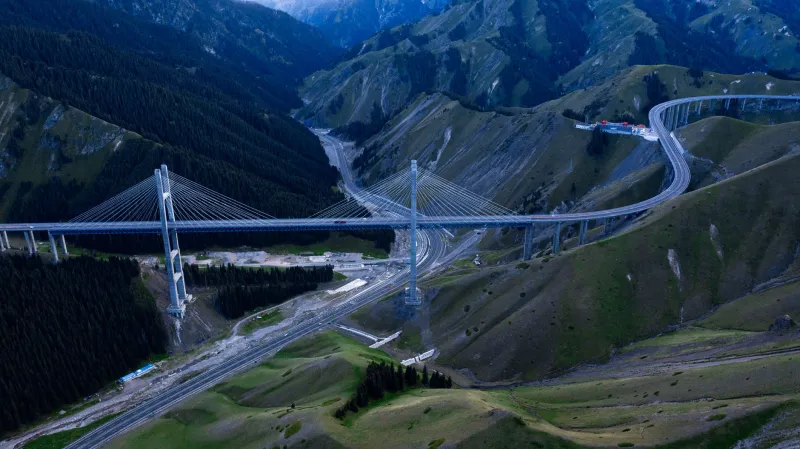
On November 7, 1940, a suspension bridge spanning the Tacoma Narrows in Washington State twisted itself into oblivion in front of newsreel cameras, producing one of the most studied engineering disasters in American history. The footage is arresting: a massive steel structure undulating like a ribbon in a breeze, its roadway pitching at angles that would be implausible in any architectural drawing. Within hours, the bridge collapsed into Puget Sound. What the cameras captured, however, was not simply a construction blunder. It was a masterclass in the physics of resonance—a phenomenon that sits at the intersection of classical wave mechanics, fluid dynamics, and structural engineering.
Natural Frequency and the Concept of Resonance
Every physical structure, from a tuning fork to a skyscraper, possesses one or more natural frequencies: specific rates at which the object will oscillate when disturbed and then left alone. These frequencies are determined by the object's mass distribution, geometry, and material stiffness. When an external periodic force is applied at or near a structure's natural frequency, the system absorbs energy with exceptional efficiency. Each successive push, even a gentle one, adds to the amplitude of oscillation rather than being absorbed or dissipated. This accumulation is resonance.
The mathematics governing this behavior arise from the differential equation for a driven harmonic oscillator. In its simplest form, a structure subject to a periodic driving force F(t) = F₀ cos(ωt) will exhibit oscillations whose amplitude grows dramatically as the driving frequency ω approaches the natural frequency ω₀. In the absence of sufficient damping—a mechanism for shedding that accumulated energy—the amplitude can, in theory, grow without bound. In practice, material limits are reached first, and structures fail.
For bridges, natural frequencies are not abstract numbers. They are physical realities that engineers must calculate, measure, and design around.
What Actually Happened at Tacoma Narrows
For decades, the Tacoma Narrows collapse was described in textbooks as a straightforward resonance event: wind blew at a frequency matching the bridge's natural frequency, and the structure shook itself apart. This explanation is appealingly simple, but it is also incomplete and, in important respects, misleading.
The wind speed on the day of the collapse was approximately 42 miles per hour—not exceptionally high for the region. More critically, the wind was steady, not oscillating at a particular frequency. The mechanism at work was something more subtle and, in some ways, more insidious: aeroelastic flutter.
Aeroelastic flutter occurs when a structure's own motion through a fluid medium—in this case, air—generates aerodynamic forces that feed back into and amplify that motion. The original Tacoma Narrows Bridge had an unusually shallow and solid plate-girder stiffening system along its sides, which acted less like a structural truss and more like a solid wall. As wind struck this solid profile, it created alternating vortices above and below the roadway deck in a pattern known as a Kármán vortex street. These vortices shed at a rate that interacted with the bridge's torsional (twisting) natural frequency.
Critically, as the bridge began to twist, its changing angle of attack relative to the wind altered the aerodynamic forces acting upon it in a way that reinforced the twisting motion further. The structure and the airflow entered a destructive feedback loop. This is the defining characteristic of flutter: the system is not passively driven by an external force so much as it actively extracts energy from the fluid flow through its own motion. Once flutter onset is reached, the amplitude of oscillation grows rapidly. The Tacoma Narrows Bridge had a torsional natural frequency that made it acutely vulnerable to precisely this mechanism at moderate wind speeds.
Harmonics and Mode Shapes
Understanding the collapse also requires familiarity with the concept of vibrational modes. A real bridge does not oscillate in a single, simple up-and-down pattern. It can vibrate in multiple mode shapes simultaneously—each characterized by a distinct spatial pattern of nodes (points of minimal motion) and antinodes (points of maximum displacement). The fundamental mode involves the entire span moving in phase. Higher harmonics introduce additional nodes along the span, producing more complex wave patterns.
In the hours before the Tacoma Narrows collapse, observers noted the bridge transitioning from a relatively benign two-lobed vertical oscillation to a violent single-lobed torsional mode, in which opposite edges of the roadway moved in opposite vertical directions. This torsional mode had a lower natural frequency than engineers had fully accounted for, and it was precisely this mode that the aeroelastic flutter mechanism excited so effectively.
The lesson embedded in this distinction is significant: designing a bridge to resist one mode of vibration does not guarantee resistance to others. Modern structural analysis must account for the full modal spectrum of a given design.
Engineering Responses: Damping, Geometry, and Computation
The Tacoma Narrows disaster permanently reshaped how American engineers approach bridge design, particularly for long-span suspension structures. Several categories of countermeasure have since become standard practice.
Aerodynamic deck geometry is among the most fundamental. Contemporary suspension bridges employ open-truss or streamlined box-girder deck profiles rather than solid plate girders. These shapes allow wind to pass through or flow smoothly around the structure, suppressing vortex shedding and dramatically raising the flutter onset speed. The Golden Gate Bridge in San Francisco underwent a significant retrofit in the 1950s and additional modifications thereafter, replacing solid stiffening plate girders with open trusses specifically to improve aerodynamic performance.
Tuned mass dampers (TMDs) represent a more mechanical solution. A TMD consists of a large mass—sometimes hundreds of tons—suspended within the structure on springs and connected to dashpot dampers. The system is tuned so that when the primary structure begins to oscillate at its natural frequency, the TMD oscillates out of phase, effectively counteracting the motion and dissipating energy as heat through the dampers. London's Millennium Bridge, which experienced unexpected lateral resonance induced by pedestrian footfall patterns when it opened in 2000, was subsequently retrofitted with 37 fluid-viscous dampers and 52 tuned mass dampers—a real-world demonstration that resonance vulnerabilities can emerge even in modern structures and that damping solutions remain essential tools.
Wind tunnel testing and computational fluid dynamics (CFD) now form integral components of the design process for any major long-span bridge. Scale models are subjected to controlled airflow across a range of speeds and directions, allowing engineers to identify flutter onset conditions and vortex-induced vibration susceptibility before a single cable is strung. Computational simulations complement physical testing by enabling parametric studies across thousands of design variations at a fraction of the cost of physical prototyping.
Structural health monitoring adds a real-time layer of protection to bridges already in service. Networks of accelerometers, strain gauges, and anemometers continuously record a bridge's dynamic response and compare it against baseline models. Anomalous oscillation patterns can trigger alerts long before they approach dangerous amplitudes.
Resonance as a Universal Principle
The Tacoma Narrows collapse endures as a pedagogical landmark not because bridge collapses are common—they are not, particularly in the modern era—but because it made an abstract physical principle viscerally concrete. Resonance is not confined to bridges or to engineering contexts. It governs the behavior of atoms absorbing photons, MRI machines manipulating nuclear spins, and musical instruments shaping sound. The same mathematics that describes a collapsing bridge describes the selective destruction of a wine glass by a sustained vocal tone.
For structural engineers and physicists alike, the Tacoma Narrows disaster is a reminder that natural frequencies are not merely numbers in a calculation. They are latent vulnerabilities, waiting for the right driving force to reveal them. The discipline of modern bridge engineering is, in no small measure, the science of ensuring that such a convergence never again produces catastrophe.