Tribology at the Limit: How Surface Physics Erodes the Internal Combustion Engine and Why Electric Drivetrains Rewrite the Equation
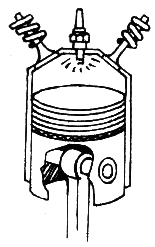
Photo: Pearson Scott Foresman, Public domain, via Wikimedia Commons
The average American drives approximately 15,000 miles per year. Over a vehicle's lifetime, the engine at the core of a conventional gasoline car will complete hundreds of millions of reciprocating cycles, each one requiring metal surfaces to slide, roll, and press against one another under conditions of extreme temperature and pressure. That the engine survives as long as it does is a genuine engineering achievement. That it eventually fails—and requires oil changes, belt replacements, valve adjustments, and ultimately a reckoning with accumulated wear—is not a design flaw. It is physics.
The scientific discipline governing these interactions is tribology: the study of friction, lubrication, and wear between surfaces in relative motion. Though it lacks the public profile of thermodynamics or electromagnetism, tribology is responsible for an enormous fraction of the energy losses and material costs embedded in the transportation sector. Understanding its principles reveals why conventional powertrains are so maintenance-intensive, and why the architecture of electric motors represents a fundamentally different—and thermodynamically less costly—approach to converting energy into motion.
The Physics of Friction: Not a Single Force
Friction is frequently introduced in undergraduate physics as a simple proportional relationship: the friction force equals the coefficient of friction multiplied by the normal force. This formulation, while useful for introductory problem sets, obscures the genuine complexity of what happens when real surfaces interact.
Real surfaces are not smooth at the microscopic scale. Even precision-machined metal components are covered in asperities—microscopic peaks and valleys whose characteristic heights and spacings depend on the manufacturing process and material properties. When two such surfaces are pressed together, actual contact occurs only at the tips of these asperities. The true contact area is typically a small fraction—often less than one percent—of the apparent geometric contact area.
At each asperity contact, local pressures can reach values far exceeding the macroscopic average, sufficient to cause plastic deformation, adhesion, and in some cases, welding of the contact junctions. Relative sliding motion then shears these junctions, dissipating energy as heat and progressively removing material from both surfaces. This is adhesive wear, and it is one of the primary mechanisms degrading engine components over time.
A second major mechanism is abrasive wear, in which harder particles—either from combustion byproducts, atmospheric contamination entering through the air intake, or debris generated by adhesive wear itself—plow through softer surface material like a microscopic cutting tool. This is why engine oil must be replaced rather than simply topped off: it accumulates particulate contamination that transforms the lubricant from a protective medium into an abrasive one.
Entropy, Degradation, and the Thermodynamics of Wear
Wear is, at its thermodynamic root, an entropy-generating process. The ordered crystalline structure of a metal surface is progressively disordered through mechanical work, heat cycling, and chemical attack from combustion gases and oxidized lubricant. The second law of thermodynamics does not merely permit this degradation—it drives it. Energy dissipated as heat at asperity contacts raises local temperatures, accelerating chemical reaction rates (including oxidative corrosion of metal surfaces) in accordance with the Arrhenius equation. Higher temperatures mean faster chemistry, faster chemistry means faster degradation, and the cycle is self-reinforcing.
In a typical four-cylinder gasoline engine, the piston rings represent one of the most tribologically demanding interfaces. These rings must maintain a dynamic seal against the cylinder wall while the piston reciprocates at rates that can exceed 50 cycles per second at highway speeds. The contact stress, sliding velocity, and thermal environment at this interface push lubricant films to their operational limits. Elastohydrodynamic lubrication theory—which accounts for the deformation of contacting surfaces under load and the pressure-dependent viscosity of the lubricant—predicts film thicknesses in the range of 0.1 to 1 micrometer at these conditions. When the film fails, direct asperity contact resumes, and wear accelerates.
The engine's lubrication system exists specifically to manage this threat. Motor oil is not merely a friction reducer; it is a carefully engineered fluid containing base stocks, viscosity index improvers, antioxidants, detergents, dispersants, and anti-wear additives such as zinc dialkyldithiophosphate (ZDDP). Each additive addresses a specific degradation mechanism. The complexity of the formulation reflects the complexity of the problem.
Counting the Contacts: A Conventional Powertrain's Tribological Burden
The full tribological inventory of a conventional internal combustion vehicle is extensive. The engine alone contains hundreds of sliding and rolling contacts: piston rings against cylinder walls, connecting rod bearings on crankshaft journals, camshaft lobes against valve lifters, timing chain or belt links against guides and tensioners. The transmission adds planetary gear sets, clutch packs, and torque converter internals. The differential introduces hypoid gear contacts operating under extreme pressure. Each subsystem requires its own lubrication strategy, its own service interval, and its own failure mode.
The U.S. Department of Energy has estimated that approximately 33 percent of fuel energy in a light-duty gasoline vehicle is lost to friction in the engine, drivetrain, and accessories. Of that, the engine itself accounts for the majority. Reducing these losses by even a few percentage points across the national vehicle fleet would represent a substantial reduction in fuel consumption—a recognition that has driven decades of research into low-friction coatings, improved lubricant formulations, and surface texturing techniques.
Electric Motors: A Structurally Simpler Tribological Problem
A battery-electric vehicle's drivetrain does not eliminate tribology, but it reduces the scope of the problem dramatically. A typical permanent magnet AC motor contains one primary moving interface: the shaft rotating within its bearings. There are no piston rings, no valve trains, no timing systems, no multi-speed transmissions in many single-speed EV designs, and no fluid couplings. The number of lubricated contacts drops from the hundreds present in a conventional powertrain to a handful.
Bearing tribology is a well-characterized and relatively manageable problem. Modern rolling element bearings—ball bearings and tapered roller bearings—operate in the elastohydrodynamic lubrication regime with film thicknesses sufficient to prevent significant asperity contact under normal operating conditions. Bearing greases are formulated for long service lives, and in many EV applications, bearings are expected to last the lifetime of the vehicle without replacement.
The thermal environment is also fundamentally different. An internal combustion engine operates with peak cylinder temperatures exceeding 2,000°C during combustion, creating extreme thermal gradients that challenge lubricant stability and drive differential thermal expansion between components. An electric motor generates heat primarily through resistive losses in the windings (I²R heating) and core losses in the magnetic circuit—significant engineering challenges, but ones that occur at far lower temperatures and without the chemical aggression of combustion gases.
Regenerative Braking and the Tribological Dividend
One underappreciated tribological advantage of electric drivetrains is the effect of regenerative braking on conventional friction brake wear. In a gasoline vehicle, all kinetic energy dissipated during braking is converted to heat at the brake rotor and pad interface—a tribologically intensive process that progressively wears both components. An electric vehicle captures a substantial fraction of that energy electrically, reducing the mechanical braking demand and extending brake component life significantly. Tesla has reported that some of its vehicles require brake pad replacement far less frequently than conventional vehicles, if at all within normal ownership periods.
This is not merely a maintenance convenience. It reflects a genuine thermodynamic difference: energy that would have been irreversibly dissipated as heat at a friction interface is instead returned to the battery as electrical energy, reducing both wear and entropy generation in the braking system.
The Fundamental Shift
Tribology does not disappear in an electric vehicle—it is simply confined to a much smaller set of interfaces operating under less extreme conditions. This reduction in tribological burden is not incidental to the EV transition; it is one of its defining physical characteristics. The internal combustion engine is, at its core, a machine that converts chemical energy into motion by way of controlled explosions, and managing the mechanical consequences of that violence requires an elaborate and maintenance-intensive tribological infrastructure. The electric motor converts electromagnetic energy into rotational motion through a process that is inherently gentler on its own components.
For students and researchers examining the physics of energy conversion and material longevity, the contrast between these two architectures is instructive. The laws of thermodynamics do not favor one technology over another—entropy increases regardless. But the rate at which a system generates entropy, and the structural complexity required to manage the consequences, varies enormously with design. In that variation lies the physical explanation for a fundamental shift in how transportation systems are built and maintained.