Magnetosphere Under Pressure: The Lorentz Force, Solar Wind, and the Risks of a Weakening Geomagnetic Field
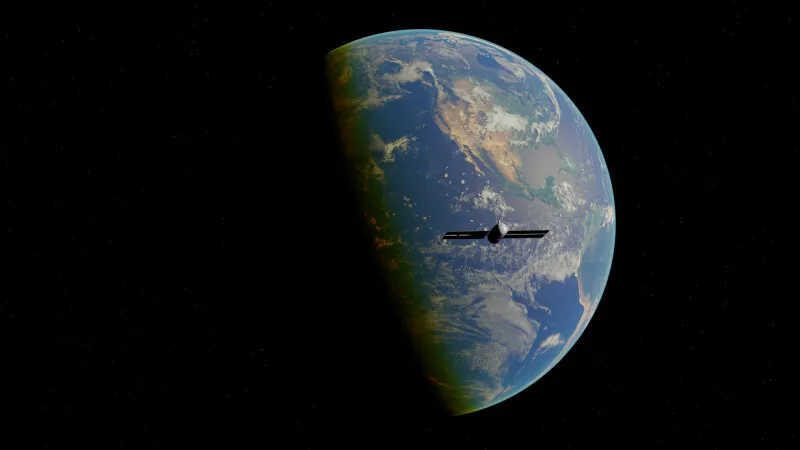
The surface of Earth is, by cosmic standards, a remarkably sheltered environment. The sun continuously expels a supersonic stream of ionized plasma — electrons, protons, and heavier ions — outward through the solar system at velocities ranging from roughly 400 to 800 kilometers per second. Were this solar wind to strike Earth's atmosphere directly and without obstruction, the consequences for surface life and technological infrastructure would be severe. That it largely does not is a consequence of a geophysical system so large and so fundamental that it rarely receives the analytical attention it deserves: the magnetosphere.
Understanding how this system works, why it is currently changing, and what the implications of that change might be requires engaging with some of the most important concepts in classical electromagnetism — concepts that connect directly to the physics encountered in any rigorous undergraduate curriculum.
The Lorentz Force as a Planetary Shield
The mechanism by which Earth's magnetic field deflects charged particles is not absorption or reflection in the optical sense. It is the Lorentz force — the force experienced by a charged particle moving through a magnetic field, expressed as F = q(v × B), where q is the particle's charge, v is its velocity vector, and B is the magnetic field vector.
The critical feature of this force is its geometry. Because the Lorentz force acts perpendicular to both the particle's velocity and the local magnetic field direction, it does not do work on the particle — it does not change the particle's speed, only its direction. A charged particle entering a uniform magnetic field therefore does not slow down; it curves. If the field is strong enough and the particle's energy is not too extreme, the curvature is sufficient to redirect the particle away from the planet entirely or to trap it in a spiraling trajectory along field lines.
For particles approaching Earth from the direction of the sun, this deflection begins far from the surface. The magnetopause — the boundary where the solar wind's dynamic pressure is balanced by the magnetic pressure of Earth's field — typically lies approximately 10 Earth radii upstream on the sun-facing side. The region of space dominated by Earth's magnetic influence, the magnetosphere, extends tens of thousands of kilometers in every direction, with a long magnetotail stretching hundreds of Earth radii in the anti-sunward direction.
Particles that are not fully deflected at the magnetopause can be captured into the Van Allen radiation belts — two toroidal regions of trapped energetic particles that encircle the planet. Particles within these belts execute a complex motion: they spiral along field lines between hemispheres, drift longitudinally around the planet, and remain trapped for timescales ranging from hours to years depending on their energy and the stability of the field configuration.
Where the Shield Fails: Auroras and the Polar Cusps
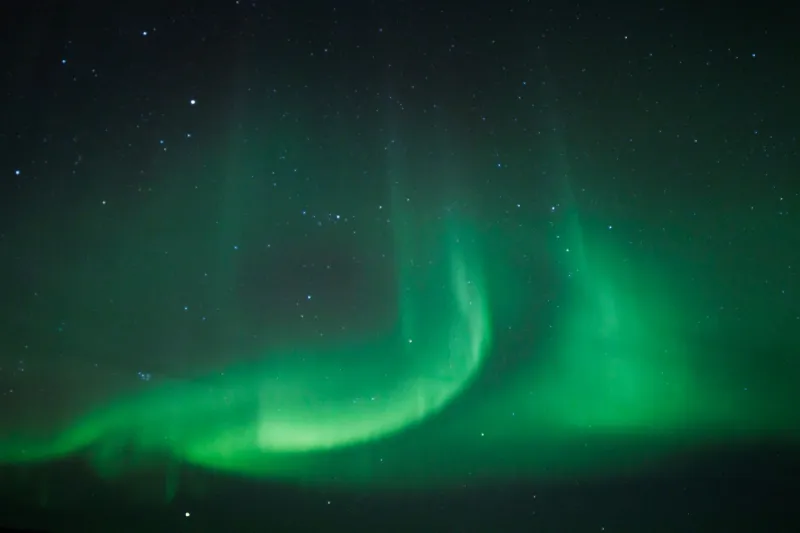
The magnetosphere is not a perfect barrier. At the polar regions, the geometry of Earth's dipole field creates structures called polar cusps where field lines converge and particles can funnel directly toward the upper atmosphere. This is why auroras — the visual manifestation of energetic particle collisions with atmospheric gases — occur predominantly at high latitudes. The aurora borealis and aurora australis are, in a precise physical sense, the locations where the shield is thinnest, and where solar wind particles gain their most direct access to the planet.
The specific colors of auroral displays encode information about the atmospheric composition and altitude of the collisions. Green light, the most commonly observed color, results from excited oxygen atoms at altitudes of roughly 100 to 150 kilometers. Red auroras arise from oxygen at higher altitudes, above 200 kilometers, while blue and purple hues indicate nitrogen molecule interactions. For atmospheric physicists and space weather researchers, auroral spectroscopy is a diagnostic tool as much as it is a spectacle.
The South Atlantic Anomaly: A Regional Vulnerability
Earth's magnetic field is not uniform. The geomagnetic dipole is offset from the planet's geometric center and tilted relative to the rotational axis, producing regional variations in field strength. The most significant of these anomalies — and the one of greatest current concern — is the South Atlantic Anomaly (SAA), a broad region centered roughly over South America and the South Atlantic Ocean where the magnetic field is substantially weaker than elsewhere at equivalent latitudes.
The SAA has been documented for decades, but recent measurements from the European Space Agency's Swarm satellite constellation and other monitoring systems indicate that it is both expanding and intensifying. Over the past two centuries, Earth's overall magnetic field strength has declined by approximately 9 percent, and the SAA represents a region where this weakening is most pronounced. Additionally, researchers have identified evidence that the SAA may be splitting into two distinct anomalous regions, a development whose long-term significance remains under active investigation.
The practical consequences of the SAA are already measurable. Satellites passing through the region experience elevated rates of single-event upsets — bit-flips in onboard electronics caused by energetic particle strikes. NASA and other space agencies have long been aware that the SAA represents an elevated radiation environment; the International Space Station crew is monitored for increased exposure during passes through the anomaly, and certain sensitive instruments are powered down during those transits. As the anomaly expands, these operational challenges will intensify.
Geomagnetic Reversals: Historical Context and Physical Mechanism
The current weakening of Earth's field raises a question that geophysicists have studied for decades: is this a transient fluctuation, or is it a precursor to a geomagnetic reversal — an event in which the magnetic north and south poles exchange positions?
The paleomagnetic record, preserved in the alignment of magnetic minerals in ancient volcanic rocks, provides unambiguous evidence that reversals have occurred throughout Earth's history. The most recent reversal, known as the Brunhes-Matuyama transition, occurred approximately 780,000 years ago. On geological timescales, reversals are not rare; they occur irregularly, with intervals between events ranging from tens of thousands to millions of years.
The physical mechanism driving reversals lies in Earth's outer core, where the motion of liquid iron generates the geodynamo — the self-sustaining electromagnetic process that produces the global magnetic field. Numerical simulations of core convection demonstrate that the geodynamo can spontaneously transition between polarity states when fluid flow patterns reorganize sufficiently. During a reversal, the field does not simply flip instantaneously; it weakens, becomes multipolar and spatially complex for a period estimated at anywhere from a few centuries to several thousand years, and then re-establishes a dipole configuration in the opposite orientation.
Whether the current weakening represents the onset of such a transition or simply a fluctuation within the normal range of geomagnetic variability is a question that cannot yet be answered with certainty. Some researchers point to the SAA's behavior and the observed acceleration of the magnetic north pole's drift toward Siberia as suggestive indicators. Others emphasize that similar episodes of weakening have occurred in the past without culminating in full reversals.
Infrastructure at Risk: Space Weather in the Modern Context
Regardless of whether a reversal is imminent, the physics of a weakened magnetic field has direct implications for systems that Americans rely on daily. The power grid is particularly vulnerable to geomagnetic storms — events in which solar coronal mass ejections compress and distort the magnetosphere, inducing geomagnetically induced currents in long ground-based conductors such as power transmission lines and pipelines. The 1989 Quebec blackout, which left millions without power for approximately nine hours, resulted from a geomagnetic storm that overwhelmed the provincial grid's protection systems. A significantly weaker baseline field would lower the threshold at which such events cause damage.
Satellite operators face compounding risks. Elevated particle flux in a weakened field environment accelerates the degradation of solar panels, increases the probability of electronics anomalies, and raises radiation exposure for astronauts on any future long-duration missions beyond low Earth orbit. The GPS infrastructure that underlies navigation, financial transaction timing, and telecommunications synchronization throughout the United States depends on satellites operating within the magnetospheric environment; sustained deterioration of that environment is a recognized concern in national space weather policy discussions.
At the surface, a substantially weakened field would allow more ultraviolet and cosmic ray flux to reach lower atmospheric levels, with potential long-term implications for cancer risk and atmospheric chemistry. These effects would not manifest suddenly or uniformly, but their gradual accumulation over the timescale of a reversal transition would represent a meaningful change in the planetary radiation environment.
A Dynamic System, Not a Static Given
Perhaps the most important conceptual shift that studying the magnetosphere requires is recognizing that Earth's protective field is not a fixed feature of the planet's environment. It is the output of an ongoing physical process — the geodynamo — that operates on timescales far longer than human civilization but far shorter than the age of the planet. The field has changed before, dramatically, and the physics governing it does not guarantee its current configuration in perpetuity.
For students of electromagnetism, the magnetosphere offers a planetary-scale application of principles introduced in the context of laboratory-sized systems: the Lorentz force, magnetic pressure, plasma confinement, and electromagnetic induction all appear in the magnetospheric physics literature in recognizable forms. For researchers and policymakers, the magnetosphere represents a system whose behavior has measurable consequences for infrastructure and public health — consequences that merit sustained scientific attention and, increasingly, practical preparation.