Relativity as Infrastructure: The Orbital Mechanics and Spacetime Corrections Keeping GPS Accurate to the Meter
Einstein's theories of relativity occupy an unusual cultural position in the United States. They are simultaneously celebrated as among the greatest intellectual achievements in scientific history and widely regarded as relevant only to exotic circumstances — the interiors of black holes, the early universe, the behavior of particles accelerating toward the speed of light. This perception is understandable but incorrect. Every time an American driver follows turn-by-turn navigation on a smartphone, every time a commercial aircraft confirms its position over the Pacific, every time a surveying instrument determines a property boundary to centimeter precision, the infrastructure producing those results is actively compensating for relativistic effects predicted by equations Einstein published between 1905 and 1915.
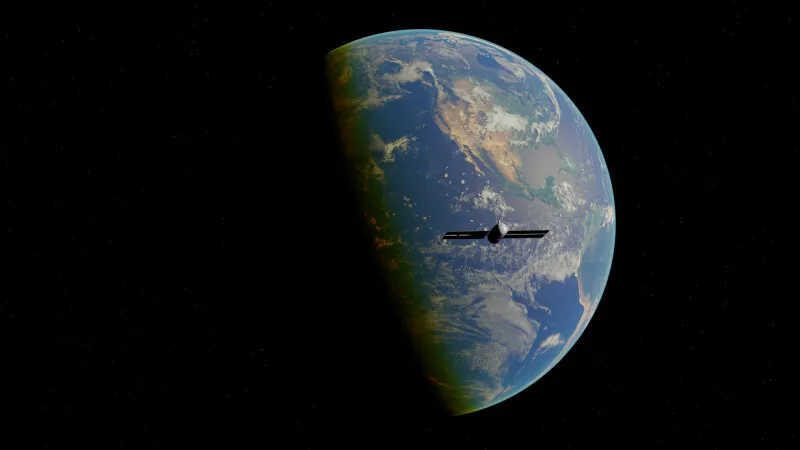
The Global Positioning System, operated by the United States Space Force and consisting of at least 24 operational satellites in medium Earth orbit, is perhaps the most consequential engineering system in daily American life that most users never think about. It is also, without exaggeration, a piece of infrastructure that would fail within hours if its designers had ignored relativistic physics.
 Photo: United States Space Force, via www.siegelgale.com
How GPS Actually Determines Position
Before examining the relativistic corrections, it is worth establishing precisely how GPS positioning works, because the mechanism makes clear why timekeeping accuracy is so critical.
Each GPS satellite continuously broadcasts a signal containing two pieces of information: the satellite's precise orbital position and the exact time at which the signal was transmitted, as measured by an atomic clock aboard the satellite. A GPS receiver on the ground intercepts signals from multiple satellites simultaneously and computes the time elapsed between transmission and reception for each. Since electromagnetic signals travel at the speed of light — approximately 299,792,458 meters per second — each time measurement translates directly into a distance measurement: a sphere of possible receiver positions centered on the transmitting satellite.
With signals from four or more satellites, the receiver can solve for its three-dimensional position and correct for its own clock offset. The geometry is elegant, but the accuracy of the entire calculation rests entirely on the precision of the timestamps. An error of one microsecond in the timing data corresponds to a positional error of roughly 300 meters. The atomic clocks aboard GPS satellites are accurate to approximately 20 to 30 nanoseconds — more than sufficient for meter-level positioning, but only after relativistic corrections are applied. Without those corrections, the clocks would drift by about 38 microseconds per day, accumulating positional errors at a rate of approximately 10 kilometers daily.
The Special Relativistic Effect: Velocity-Dependent Time Dilation
GPS satellites orbit at an altitude of approximately 20,200 kilometers, completing two full orbits every sidereal day at an orbital velocity of roughly 3.87 kilometers per second. According to special relativity, a clock in motion relative to an observer runs slow — a phenomenon known as time dilation, described by the Lorentz factor.
The relevant expression for the fractional rate difference between a moving clock and a stationary reference is:
$$\frac{\Delta f}{f} = -\frac{v^2}{2c^2}$$
where v is the satellite's orbital velocity and c is the speed of light. Substituting the GPS orbital velocity yields a fractional frequency shift of approximately −8.349 × 10⁻¹¹. Over the course of one day (86,400 seconds), this causes satellite clocks to lose approximately 7.2 microseconds relative to clocks on the Earth's surface.
This effect alone, if uncompensated, would introduce timing errors that compound into positional errors of several kilometers per day. But special relativity accounts for only part of the total correction required.
The General Relativistic Effect: Gravitational Time Dilation
General relativity introduces a second, and larger, time dilation mechanism. Einstein's equivalence principle and the resulting field equations predict that clocks in stronger gravitational fields tick more slowly than clocks in weaker fields. This is gravitational time dilation, and it operates in the opposite direction from the velocity effect for GPS satellites.
At an altitude of 20,200 kilometers, GPS satellites experience a gravitational potential significantly weaker than that at Earth's surface. The fractional frequency shift due to this difference in gravitational potential is given by:
$$\frac{\Delta f}{f} = \frac{\Delta \Phi}{c^2} = \frac{GM}{c^2}\left(\frac{1}{R_E} - \frac{1}{r}\right)$$
where G is the gravitational constant, M is Earth's mass, R_E is Earth's mean radius, and r is the orbital radius of the satellite. Evaluating this expression for the GPS orbital altitude yields a fractional shift of approximately +5.284 × 10⁻¹⁰. Over one day, this causes satellite clocks to gain approximately 45.6 microseconds relative to surface clocks.
Combining both effects — the −7.2 microseconds from special relativity and the +45.6 microseconds from general relativity — yields a net daily gain of approximately +38.4 microseconds. This is the figure that appears frequently in discussions of GPS and relativity, and it is not a rounding artifact or an approximation for pedagogical convenience. It is the actual accumulated drift that must be corrected to maintain system integrity.
How the Correction Is Implemented
The GPS system handles this discrepancy through a combination of pre-launch hardware adjustment and ongoing ground-based monitoring. Before satellites are deployed, the oscillators driving their atomic clocks are deliberately set to run slightly slow — at a frequency of 10.22999999543 MHz rather than the nominal 10.23 MHz. This offset precisely compensates for the expected net relativistic gain once the satellite reaches operational orbit, so that the satellite's clock ticks in synchrony with clocks on the ground from the moment it begins transmitting.
Additionally, because GPS satellites follow slightly elliptical orbits, both their velocity and their altitude — and therefore both relativistic effects — vary periodically over each orbital period. The ground control segment, operated from Schriever Space Force Base in Colorado, continuously monitors satellite clock performance and uploads periodic correction parameters to account for these variations, as well as for residual effects including the Sagnac effect arising from Earth's rotation.
Relativity as an Engineering Requirement
The GPS case is instructive precisely because it is so mundane in its context. The relativistic corrections built into the system are not theoretical refinements applied after the fact; they were incorporated into the original design specifications because the engineers and physicists working on the program in the 1970s understood that the system would not function without them. The physics demanded it.
This represents a broader truth about fundamental science that is sometimes obscured in public discourse: theoretical frameworks developed to describe nature at its most abstract frequently become engineering constraints at the most practical level. The same equations that describe the warping of spacetime around a neutron star also determine whether a rideshare driver in Chicago arrives at the correct address. General relativity is not merely a framework for cosmologists. For the tens of millions of Americans who rely on GPS-dependent systems every day, it is quietly, invisibly, indispensably at work — a correction running in the background, keeping the geometry of everyday life aligned with the geometry of spacetime.