Compressibility, Shock Formation, and the Transonic Regime: What Actually Happens Near Mach 1
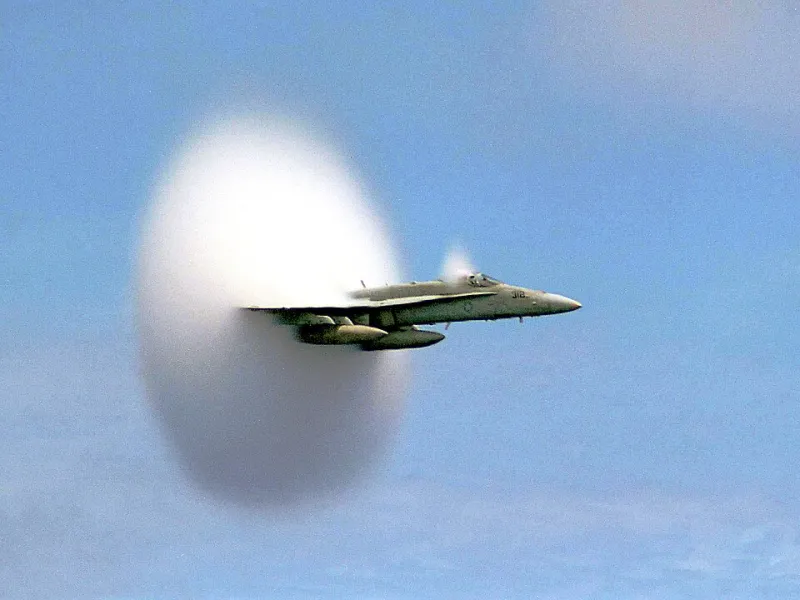
Photo: Ensign John Gay, U.S. Navy, Public domain, via Wikimedia Commons
On October 14, 1947, Charles "Chuck" Yeager piloted the Bell X-1 through Mach 1 over the Mojave Desert and, according to the popular account, broke the sound barrier. The phrase was already in circulation before that flight, used by journalists and the public to describe what many believed was a physical wall in the atmosphere—a wall that had claimed aircraft and, some speculated, might be fundamentally impassable. When Yeager's aircraft survived, the narrative became one of human ingenuity overcoming a natural obstacle.
The problem with this story is not that it is factually wrong about the flight. It is that the metaphor of a barrier is so structurally misleading that it inverts the actual physics. There is no wall. There is no threshold that, once crossed, leaves turbulence and danger behind. What aeronautical engineers actually contend with in the transonic regime—the range of Mach numbers from roughly 0.8 to 1.2—is a set of fluid dynamic phenomena that are in many respects more challenging below Mach 1 than above it.
Air as a Compressible Medium
At low speeds, air behaves for most engineering purposes as an incompressible fluid. The pressure disturbances generated by a moving object propagate outward at the speed of sound, approximately 767 miles per hour at sea level under standard conditions, and the flow adjusts smoothly ahead of the object. Streamlines shift gradually, pressure gradients are gentle, and the standard tools of incompressible aerodynamics—Bernoulli's equation, thin airfoil theory—apply with acceptable accuracy.
As an aircraft's speed approaches the speed of sound, this picture begins to break down. The pressure waves generated by the aircraft can no longer outrun it, and they begin to pile up. More precisely, the local flow velocity over curved surfaces—particularly the upper surface of a wing, where flow accelerates—can exceed Mach 1 even when the aircraft itself is still flying below that speed. An aircraft traveling at Mach 0.75 may already have regions of supersonic flow on its wing surfaces.
This is the essence of the transonic regime, and it is why the "barrier" metaphor fails so completely. The aerodynamic complications of high-speed flight do not appear suddenly at Mach 1. They develop progressively, beginning well below that speed, as compressibility effects become significant and local supersonic pockets form on the aircraft's surfaces.
The von Kármán Pressure Coefficient and Critical Mach Number
The critical Mach number of an airfoil is defined as the freestream Mach number at which local flow somewhere on the surface first reaches Mach 1. It is a design parameter of fundamental importance because it marks the onset of shock wave formation on the wing. Above the critical Mach number, a small normal shock wave forms at the point where local flow transitions from supersonic back to subsonic. This shock is not the dramatic conical shock wave associated with fully supersonic flight; it is a thin, nearly perpendicular discontinuity in flow properties embedded within the subsonic freestream.
The von Kármán pressure coefficient relation, which corrects the incompressible pressure coefficient for compressibility effects, allows aerodynamicists to estimate where local sonic conditions will first be reached for a given airfoil geometry and freestream Mach number. The relation captures the nonlinear stiffening of air as it is compressed—the same physical effect that makes high-speed aerodynamics fundamentally different from low-speed aerodynamics and that renders purely incompressible analysis dangerously inadequate above roughly Mach 0.3.
As the freestream Mach number increases beyond the critical value, the embedded shock on the wing strengthens and moves rearward. The pressure rise across the shock is abrupt and severe, and it interacts with the boundary layer—the thin region of viscosity-dominated flow immediately adjacent to the wing surface—in ways that can be catastrophic.
Shock-Induced Separation and the Transonic Drag Rise
The boundary layer is, in a sense, the most important few millimeters in aeronautics. It is the layer within which all viscous effects are concentrated, and its behavior determines whether flow remains attached to the wing surface—generating lift efficiently—or separates, generating a turbulent wake and dramatic increases in pressure drag.
When a shock wave intersects the boundary layer, it imposes a sudden adverse pressure gradient. The boundary layer, which has limited momentum reserves, may be unable to negotiate this pressure rise and will separate from the surface downstream of the shock. This shock-induced separation disrupts lift generation, increases drag sharply, and can produce severe buffeting—structural vibrations transmitted through the airframe—that in early high-speed aircraft was violent enough to cause loss of control.
The transonic drag rise, the steep increase in aerodynamic drag that occurs as an aircraft approaches Mach 1, is primarily a consequence of these shock formations and their interactions with the boundary layer. It is not a wall. It is a steep hill, and the slope of that hill depends on airfoil design, wing sweep angle, and fuselage cross-sectional area distribution.
The area rule, developed by NACA engineer Richard Whitcomb in the early 1950s, addresses the drag rise by shaping the fuselage to maintain a smooth variation in total cross-sectional area along the aircraft's length. The "wasp-waisted" or "Coke bottle" fuselage shape that resulted from applying this principle to early supersonic aircraft designs is a direct physical response to transonic wave drag—not to any barrier, but to the compressibility-driven pressure field that builds around an aircraft as it approaches Mach 1.
What Supersonic Flight Actually Resolves
Once an aircraft exceeds Mach 1 throughout, the aerodynamic situation changes in important ways. The shock waves that were embedded within the flow field and interacting destructively with the boundary layer reorganize into attached oblique shocks anchored to the aircraft's leading edges and nose. The flow structure becomes, in some respects, more predictable. Supersonic aerodynamics, governed by the method of characteristics and linear supersonic theory, is in many ways mathematically cleaner than the nonlinear, shock-laden transonic regime.
This is the genuine physical truth obscured by the barrier metaphor. The hardest part of supersonic flight, aerodynamically speaking, is not arriving at Mach 1—it is passing through the transonic regime where shock waves are forming, migrating, and interacting with boundary layers in complex, nonlinear ways. Yeager's aircraft did not smash through a wall; it navigated a difficult transition in fluid behavior that engineers had worked carefully to design around.
Ongoing Research and Practical Stakes
Transonic aerodynamics remains an active research frontier precisely because the regime is so demanding. Modern computational fluid dynamics codes must handle mixed subsonic-supersonic flow fields, shock-boundary layer interactions, and unsteady buffet phenomena simultaneously—a computational challenge that required decades of algorithmic development to address adequately.
For the renewed commercial supersonic transport programs being developed by companies such as Boom Supersonic, managing the transonic phase of flight is central to achieving acceptable fuel efficiency and structural loads. The physics has not changed since 1947. The computational tools and materials available to work within those physics have improved enormously.
The sound barrier was never a barrier. It was always a description of a regime—one that rewards careful physical thinking and penalizes the comfort of simple metaphors.