Shaped Disturbance: Shock Wave Geometry, Boom Carpets, and the Aerodynamic Quest for Quieter Supersonic Flight
The last time a commercial aircraft flew supersonic passengers across the continental United States, the year was 1973. The Concorde, though a technological achievement of considerable distinction, never received approval to operate overland routes in America. The Federal Aviation Administration's prohibition was not primarily a political judgment. It was a response to the physics of supersonic flight—specifically, to the sustained pressure disturbance that a supersonic aircraft drags across the landscape below it, a phenomenon known as the sonic boom carpet.
Fifty years later, that prohibition remains in force. But the physics being applied to circumvent its consequences have never been more sophisticated.
Why Supersonic Aircraft Generate Shocks
At subsonic speeds, an aircraft's pressure disturbances propagate ahead of it as sound waves, allowing the surrounding air to adjust smoothly to the approaching body. As flight speed approaches and exceeds the speed of sound—approximately 343 meters per second at sea level under standard conditions—this advance warning is lost. Pressure disturbances can no longer outrun the aircraft, and they instead accumulate into thin, nearly discontinuous regions of compressed air: shock waves.
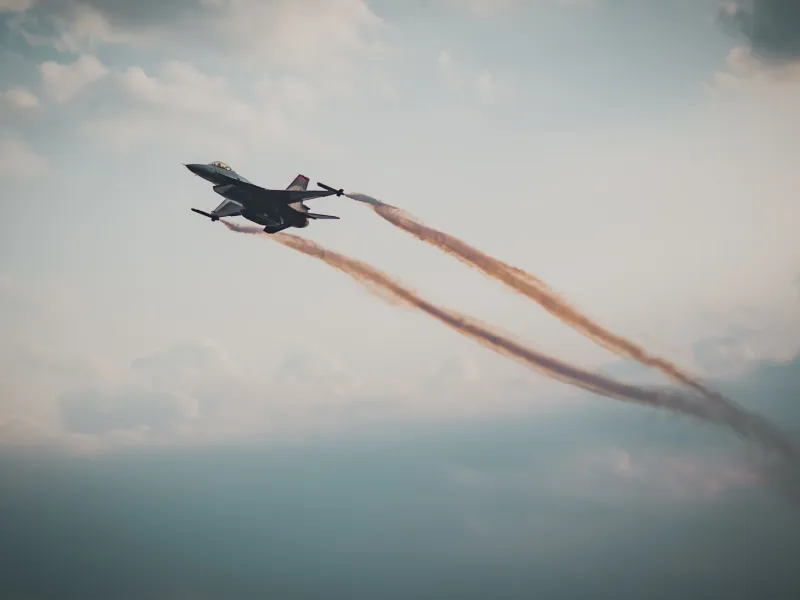
The geometry of these shocks is described by the Mach angle, defined as the inverse sine of the ratio of the speed of sound to the aircraft's speed. At Mach 1.5, this angle is approximately 42 degrees; at Mach 2.0, it narrows to 30 degrees. The resulting Mach cone—a conical shock surface trailing the aircraft—propagates outward and downward, eventually reaching the ground as a moving pressure disturbance. An observer on the ground does not hear a single event but rather experiences two distinct pressure jumps: the bow shock from the aircraft's nose and the tail shock from its rear. Together, these produce the characteristic double-boom signature familiar from military aircraft demonstrations.
The overpressure at ground level from a large supersonic transport at typical cruise altitude is on the order of 1 to 2 pounds per square foot—sufficient to rattle windows, disturb sleep, and, in the aggregate, render overland supersonic flight socially and politically untenable.
The Boom Carpet and Atmospheric Propagation
The path from a shock wave generated at 60,000 feet to a pressure pulse felt at ground level involves considerably more than simple geometric projection. The atmosphere is not a uniform medium. Temperature and density decrease with altitude, which causes acoustic rays to refract according to Snell's law of wave propagation: waves bend toward regions of lower sound speed. This refraction can, under certain atmospheric conditions, create cutoff Mach numbers below which the shock never reaches the ground—a phenomenon that has been exploited in proposals for very high-altitude supersonic cruise.
However, atmospheric variability complicates this picture substantially. Wind shear, temperature inversions, and turbulence all perturb shock wave propagation, scattering energy in ways that are difficult to predict deterministically. The boom carpet—the swath of ground beneath a supersonic aircraft's track that experiences elevated overpressure—has irregular edges and variable intensity depending on atmospheric conditions at the time of flight. This variability has historically made regulatory standards difficult to define and enforce.
Focused booms present a separate concern. Under certain geometries of aircraft maneuvering—particularly during acceleration through Mach 1 or during turns—shock waves from different parts of the flight path can converge constructively at the ground, producing overpressures several times greater than those from steady cruise. These focused events are transient but intense, and they represent a distinct physical phenomenon from the steady-state boom carpet of level supersonic flight.
Shaping the Shock: Low-Boom Aircraft Design
The central insight driving modern low-boom research is that the ground-level signature of a sonic boom is not fixed by the aircraft's speed alone but is sensitive to the longitudinal distribution of lift and volume along the aircraft's length. This relationship is formalized in the equivalent area concept, derived from the supersonic area rule and the work of researchers including Richard Whitcomb at what was then the National Advisory Committee for Aeronautics in the 1950s.
For a conventional supersonic aircraft, lift and volume are concentrated near the nose and wing, producing a sharp N-wave pressure signature at the ground: a sudden positive pressure jump followed by a gradual expansion and a final positive jump at the tail shock. The N-wave is perceptually loud because its steep pressure gradients couple efficiently to the human auditory system and to structures.
By redistributing lift and volume more uniformly along the fuselage—stretching the effective pressure rise over a longer distance—designers can transform the N-wave into a ramp wave or a rounded signature with reduced peak overpressure and slower pressure gradients. The resulting boom is quieter not because the total energy in the shock has been eliminated, but because that energy is spread over a longer time interval and lower peak amplitude. The thermodynamic energy of the shock must go somewhere; shaping determines where and how quickly it arrives.
NASA's X-59 and the Physics of Demonstration
NASA's X-59 QueSST (Quiet SuperSonic Technology) aircraft, developed in partnership with Lockheed Martin's Skunk Works division, represents the most direct experimental test of low-boom shaping principles to date. The aircraft's distinctive elongated nose—approximately one-third of the vehicle's total length—is not an aesthetic choice but a functional one. It distributes the bow shock formation over a greater longitudinal distance, weakening the initial pressure jump that reaches the ground.
The X-59 is designed to produce a ground-level overpressure of approximately 75 perceived level decibels (PLdB), compared to roughly 105 PLdB for the Concorde. NASA's community response testing program, planned for multiple American cities, aims to gather empirical data on public perception of the shaped boom signature—data that may eventually inform revised FAA regulations on overland supersonic flight.
The physics embedded in this effort extend beyond aircraft geometry. Computational fluid dynamics simulations of the X-59's shock structure require solving the Euler equations of compressible flow in three dimensions, with sufficient grid resolution to capture the interaction of shocks from the canard, wing, engine nacelle, and fuselage. These interactions can amplify or attenuate the ground signature in ways that analytical models cannot fully capture, necessitating high-fidelity numerical approaches validated against wind tunnel and flight data.
The Thermodynamic Floor
For all the sophistication of low-boom shaping, a fundamental physical constraint remains. A supersonic aircraft must generate lift, and lift requires pressure differences across lifting surfaces. Those pressure differences are communicated to the surrounding fluid as waves. At supersonic speeds, those waves coalesce into shocks. The question is not whether shocks exist but how their energy is distributed in space and time when they reach the ground.
The second law of thermodynamics imposes an additional constraint: shocks are irreversible processes. The entropy increase across a shock is real and permanent. Energy that enters the shock as organized pressure disturbance exits as heat in the disturbed fluid, and some portion always propagates to the ground as audible disturbance. The engineering goal is to minimize that audible fraction, not to eliminate the underlying physical process.
This is why researchers frame the low-boom problem in terms of acceptability rather than inaudibility. The target is not a supersonic aircraft that produces no boom but one whose boom is indistinguishable from background noise at ground level, or at least no more intrusive than existing sources of urban sound. Whether that target is achievable across the full range of atmospheric conditions, aircraft weights, and cruise altitudes required for commercial operation remains an open experimental question—one that the physics community and aerospace industry are, at last, equipped to answer.