The Force That Holds the World Together—and Sometimes Tears It Apart: A Rigorous Look at Friction Across Engineering and Geophysics
Friction is so pervasive that its absence is almost impossible to imagine. Walking, driving, writing, and the structural integrity of every bolted connection in every building in the United States all depend on it. Yet friction resists clean theoretical treatment in a way that most introductory physics courses obscure. The Amontons-Coulomb laws—that friction force is proportional to normal load, independent of apparent contact area, and characterized by a single coefficient—are useful approximations that have guided engineering for three centuries. They are also, at the microscopic level, substantially incomplete. Understanding where the classical model succeeds, where it fails, and what the actual physics involves is essential for engineers designing systems where friction is either the primary mechanism of safety or the primary mechanism of failure.
The Classical Framework and Its Limits
The Amontons-Coulomb model, formalized by Charles-Augustin de Coulomb in 1781, describes friction through two coefficients: the static coefficient (μₛ), which governs the maximum force resisting the onset of sliding, and the kinetic coefficient (μₖ), which governs the force opposing motion once sliding has begun. In virtually all real material pairs, μₛ exceeds μₖ—it takes more force to initiate motion than to sustain it. The friction force in each regime is simply the product of the relevant coefficient and the normal force pressing the surfaces together.
This model is strikingly successful at engineering scales. It correctly predicts that a block of steel on a steel surface will slide at the same angle of inclination regardless of whether the block is a cube or a thin plate of identical mass—contact area does not enter the equation. It provides adequate accuracy for the design of brakes, clutches, bolted joints, and inclined conveyor systems. For a first-order analysis of any problem involving macroscopic solid contacts under moderate loads, it remains the appropriate starting point.
The model breaks down, however, under conditions that violate its assumptions. At very high contact pressures, the apparent independence from contact area fails because the real contact area—the actual area where asperities from opposing surfaces touch—approaches the apparent geometric area. At nanoscale contacts, adhesive forces between surfaces become significant relative to the applied normal load, and the Bowden-Tabor adhesion model, which attributes friction to the shear strength of adhesive junctions formed at asperity contacts, provides a more accurate description. In lubricated contacts, the interposition of a fluid film transforms the problem into one of fluid mechanics rather than solid contact mechanics.
Real Contact Area and the Asperity Model
All real surfaces, regardless of how carefully they are machined or polished, are rough at the microscopic scale. When two surfaces are pressed together, contact occurs only at the tips of asperities—microscopic protuberances whose density and height distribution are described by statistical surface roughness parameters such as the root mean square roughness (Ra) and the autocorrelation length. The real contact area is a small fraction of the apparent geometric area, typically on the order of 0.01 to 1 percent under ordinary loads.
At each asperity contact, the local pressure is sufficient to cause plastic deformation of the softer material, and adhesive bonds—van der Waals interactions, or in some cases metallic junctions—form across the interface. The friction force required to initiate sliding is the force needed to shear these junctions. Because the real contact area is proportional to the applied normal load (adding load creates more asperity contacts rather than enlarging existing ones significantly), the friction force is proportional to normal load—which is exactly what Coulomb's law states, now derived from microscopic physics rather than empirical observation.
This understanding has direct engineering consequences. Surface finish, material hardness, and the presence of oxide layers or contaminants all alter the asperity contact geometry and the strength of adhesive junctions, shifting the effective friction coefficient. Engineers designing precision mechanisms—gyroscopes, hard disk drive actuators, microelectromechanical systems (MEMS)—must account for these effects explicitly, as the classical macroscopic model provides insufficient guidance at the scales involved.
Tire-Road Interaction: Friction as a Safety-Critical Parameter
The contact between a pneumatic tire and a road surface is one of the most consequential friction interfaces in modern society. The National Highway Traffic Safety Administration estimates that tire-related factors contribute to approximately 11,000 crashes annually in the United States. Understanding the physics of this contact is therefore not merely academic.
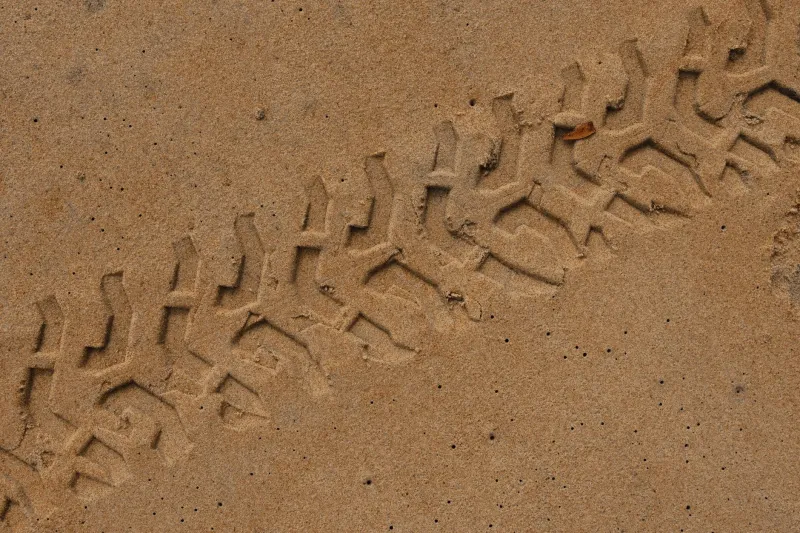
A tire's contact patch—the deformed footprint where rubber meets pavement—is the only region through which all accelerating, braking, and cornering forces are transmitted. The friction available at this interface is governed by the rubber's viscoelastic properties, the road's surface texture, and the relative motion between tire and road. Unlike a rigid solid, rubber deforms to interlock with pavement aggregate at multiple length scales simultaneously, generating friction through both adhesion at smooth contact zones and hysteresis—energy dissipation as rubber deforms and relaxes while conforming to surface asperities.
The friction circle, or friction ellipse, describes the constraint that the total friction force vector at the contact patch cannot exceed the product of the friction coefficient and the normal load. Longitudinal braking forces and lateral cornering forces compete for this limited friction budget; a vehicle braking hard while cornering is operating near the boundary of the friction ellipse, and exceeding it initiates sliding. Antilock braking systems (ABS) and electronic stability control (ESC) are, at their core, real-time friction management systems—algorithms that modulate braking and steering inputs to keep the contact patch operating within the available friction envelope.
Wet pavement reduces friction substantially by introducing a water film that must be evacuated from the contact patch before rubber-aggregate contact can occur. Tire tread patterns serve this evacuation function; worn tires on wet roads operate in a regime where hydrodynamic pressure in the water film partially supports the tire, reducing real contact area and friction in a phenomenon known as aquaplaning or hydroplaning.
Fault Mechanics: Friction at Geophysical Scales
The same physics that governs tire-road contact scales, with appropriate modifications, to the contact between tectonic plates along geological fault systems. The San Andreas Fault in California, the Cascadia Subduction Zone off the Pacific Northwest coast, and the Wasatch Fault in Utah are all interfaces where two bodies of rock are pressed together under enormous normal stresses and subject to slow relative displacement driven by plate tectonics.
The rate-and-state friction framework, developed primarily by James Dieterich and Andy Ruina beginning in the late 1970s, extends the classical Coulomb model to account for the observed dependence of fault friction on sliding velocity and the time of stationary contact. In this model, the friction coefficient is not a fixed material constant but a dynamic variable that evolves with slip rate and a state variable representing the age or maturity of asperity contacts. When slip rate increases suddenly, friction first rises (direct effect) and then decays toward a new steady-state value; when slip rate decreases, the opposite sequence occurs.
This velocity dependence determines whether a fault segment is capable of generating earthquakes. Velocity-weakening behavior—in which friction decreases as sliding velocity increases—is inherently unstable: once slip begins, reduced friction allows further acceleration, generating a runaway instability that manifests as an earthquake. Velocity-strengthening behavior is self-stabilizing and produces only slow, aseismic creep. The transition between these regimes depends on temperature, mineralogy, and the presence of fluids, which is why some fault segments lock and accumulate elastic strain over centuries while adjacent segments creep continuously.
The Parkfield segment of the San Andreas Fault has been one of the most intensively instrumented geological sites in the world precisely because it sits near the boundary between these regimes, producing magnitude 6 earthquakes with quasi-periodic recurrence that has allowed researchers to test rate-and-state predictions against observed fault behavior.
Engineering Against Friction Failure
For engineers, friction is both a resource and a hazard. In brakes, clutches, and structural connections, it is the mechanism of function; its loss is failure. In bearings, seals, and sliding mechanisms, it is the primary source of wear and energy dissipation; its minimization is the design objective. Tribology—the science of friction, lubrication, and wear—addresses both imperatives through a combination of material selection, surface engineering, and lubrication design.
Diamond-like carbon (DLC) coatings, applied to engine components in high-performance automotive applications, reduce friction coefficients to values approaching 0.05 under lubricated conditions—roughly one-fifth of the value for uncoated steel on steel. Solid lubricants such as molybdenum disulfide exploit the layered crystal structure of the material, in which weak van der Waals forces between molecular layers allow easy shear at low friction while the layers themselves resist compressive loading. These materials find application in vacuum environments—spacecraft mechanisms, for instance—where conventional liquid lubricants would evaporate.
The study of friction, in this sense, connects the most fundamental questions of surface physics to the most consequential challenges of engineering and geophysics. It is a subject in which the gap between elementary models and full physical understanding remains wide, and in which that gap has real consequences—measured in vehicle crashes, infrastructure failures, and seismic events.